

Assistant Strength and Conditioning Coach Jobs: What to Know Before You Apply
Search "assistant strength and conditioning coach jobs" and the page hands you a jobs carousel, then ten more listings. NCAA's own job board. Indeed. LinkedIn. ZipRecruiter, five times over for five different states. Not one of them tells you what the job actually is, or how someone without a title yet gets in front of one.
Openings get posted constantly. What rarely gets explained is the path that gets you considered for one, what the job actually asks of you once you have it, and whether the field is even growing. All three questions have real answers. None of them are on a job board.
The quick answer
An assistant strength and conditioning coach job is almost always an entry point, not a destination. The federal data on the broader coaching occupation this role sits inside sets no formal work-experience requirement, and a bachelor's degree is the typical bar.
College and professional programs are the exception. They typically expect you to have played the sport at some level, on top of the degree.
Most people do not walk into a posted opening cold. They get in as a graduate assistant, a volunteer, or a high school assistant first. The paid college or pro job usually comes after one of those steps, not instead of it.
What an assistant strength and conditioning coach actually does
The title covers a narrower job than "coach" suggests. An assistant runs the programming a head strength coach has already designed. Writing that programming from scratch is usually the head coach's job, not the assistant's, at least at first.
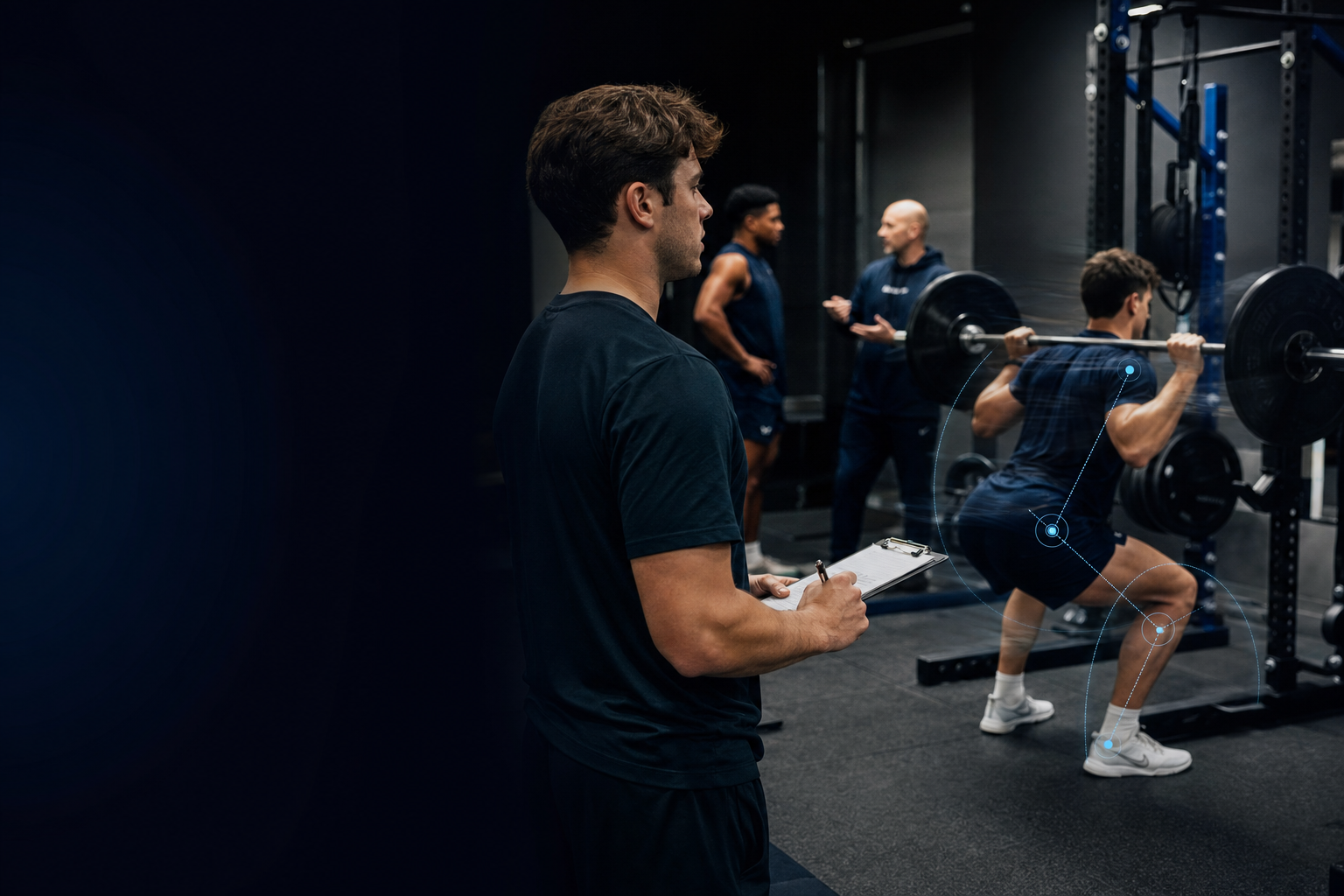
Day to day, that means supervising lifting and conditioning sessions, demonstrating and correcting technique on the floor, tracking who showed up and what they lifted, and catching a fatigued or struggling athlete before it becomes a problem the training staff has to explain later. You are often the first person an athlete talks to about how a session felt, and the main channel carrying that information back to the head coach and the medical staff.
At a smaller program, the job expands. One assistant might run warm-ups for three different sport teams in an afternoon, cover for the head coach during travel, and still be expected to know every athlete's current working weights from memory or from whatever system the program uses to track them. At a bigger program, the role narrows to one sport or even one position group, with more structure and more oversight, but less room to make programming calls on your own.
How people actually get this job
The U.S. Bureau of Labor Statistics tracks this role inside a broader occupation code, Coaches and Scouts, covering every sport and every level of coaching, not strength and conditioning specifically. Inside that code, the typical entry-level education is a bachelor's degree. There is no formal related work-experience requirement, and no on-the-job training requirement, listed for the occupation as a whole.
That is the floor, not the real bar. The same page states the exception plainly: college and professional coaching jobs typically require experience playing the sport at some level. An assistant opening at that level is competing against people who played.
The page also names the usual way in. Some college coaches begin their careers as graduate assistants or assistant coaches. Others start at the high school level and work up. Neither route is a shortcut. Both are the route.
Certification requirements mostly vary by employer rather than by a single governing rule. A common baseline is being at least 18 years old and trained in CPR and first aid. If the role also involves teaching, which many high school assistant jobs do, you need to meet your state's teaching license requirements on top of that.
None of this is fast. A graduate-assistant contract usually runs a single academic year at a time, with no promise of a second year or a promotion to a paid staff position when it ends. A volunteer season can run longer with even less structure. The honest timeline for most people is one to three unpaid or low-paid seasons before a paid assistant title, and that is normal, not a sign you are behind.
Four ways people actually get their first assistant coaching job
| Entry route | What it usually asks of you | The honest trade-off |
|---|---|---|
| Graduate assistant (college) | Enrollment in a graduate program plus an unpaid or small-stipend staff role | The standard college on-ramp, but you are not paid like a full job yet |
| Volunteer or part-time assistant (college or club) | Availability, and a willingness to start without pay | Builds the programming track record and coaching connections colleges actually screen for |
| High school assistant | A teaching license if the role is also a teaching position, plus CPR and first aid certification | A real paycheck and a stable schedule, with a smaller roster and a smaller budget |
| Private facility or team apprentice | A relevant certification such as the CSCS, and often a short unpaid trial period | A faster path to getting paid, with less structured mentorship than a college staff gives you |
None of these is the correct route. Most of the people currently on a college or pro staff passed through one of the unpaid or low-paid steps above first, often more than one of them. If a posting asks for prior assistant-coaching experience, this is usually where that experience came from. The full breakdown of how people become strength and conditioning coaches walks through the complete path, not just the entry step.
Is there real demand for this role?
Yes, broadly, and that comes with a caveat worth stating plainly. The government's Coaches and Scouts code, the same broad category this job sits inside, is projected to grow 6 percent from 2025 to 2035, faster than the average across all occupations. About 36,400 openings a year are projected on average over that decade, most of them from people transferring to a different job or leaving the workforce.
That is demand for coaching broadly, not a strength-and-conditioning-specific number. The government does not track this role separately from head coaches, assistant coaches in every other sport, and scouts. Treat the growth and openings figures as a sign the broader field is not shrinking, not as a guarantee that assistant S&C openings specifically are plentiful in your region or sport.
Where assistant openings actually get posted
The search results for this exact phrase are a decent map of where to look. That concentration is not random. Educational services, meaning schools and colleges, employs about 64 percent of everyone the government counts as a coach or scout, far more than any other industry. That lines up with why an NCAA job board shows up near the top of this search.
Expect postings on NCAA and conference job boards, a university or athletic department's own HR site, a professional association's career center, general job boards, and LinkedIn. None of them are linked here. Every one of them already ranks in the top results for this exact search, which is exactly why this site does not send readers to them as a source.
The postings that matter most rarely show up there first. Programs that are not actively posting still take an email, a resume, and a specific ask to volunteer or assist for a season. Reaching out directly, especially at the high school and small-college level, surfaces openings before they are ever listed anywhere.
The strongest version of that outreach comes with something to show, not just something to say. Greater's tools for schools and athletic programs are built around proving you can run and track a program, not just describe one, which is exactly the evidence a hiring coach is looking for from an assistant they have not worked with yet.
What the pay looks like at this level, briefly
Assistant and entry-level pay sits at the low end of the range for the field, not at the median. The full strength and conditioning coach salary breakdown covers the official wage data by industry in detail. The short version: the official median covers every level of experience and every setting, from a part-time assistant to a head coach at a major program, so an assistant's actual number lands well below it.
Making your application stand out
At this level, a long resume matters less than proof. A documented programming track record, even from an internship or a volunteer season, shows a hiring coach what you actually did rather than what you say you can do. A resume that lists duties reads like every other resume on the pile. A resume that points to a specific program you ran, for a specific group of athletes, over a specific stretch of time, does not.
A relevant certification helps, and it is worth having before you apply rather than promising to get it after. Knowing what a college program's staff actually look like day to day, covered in the guide to how college strength and conditioning programs are built, also helps you talk about the job the way the people hiring for it actually think about it, instead of the way a job posting describes it.
The strongest thing you can put in front of a hiring committee is evidence that athletes under your supervision actually progressed, with real numbers attached, not just a season summary written after the fact. That is true whether the evidence comes from a spreadsheet you kept yourself, a program you ran as a volunteer, or a tool built to track it for you. The format matters less than having it at all, since most candidates at this level show up with none.
See what you would actually be running
Greater gives assistant and head coaches a way to assign programming and show that athletes progressed, without chasing down a spreadsheet to prove it.
Try GreaterFrequently asked questions
Is there a demand for strength and conditioning coaches?
The broader coaching occupation code this role sits inside is growing faster than the average job, with tens of thousands of openings projected per year across every sport and coaching level. That is a sign the field overall is not shrinking, but it is not a strength-and-conditioning-specific count, and it says nothing about how many openings exist in your particular sport, region, or level this year.
Is it hard to get a job as a strength and conditioning coach?
At the assistant level, the formal bar is modest: a bachelor's degree, with no work experience mandated by federal data. The real competition is experience playing the sport for college and pro jobs, plus the fact that most people spend a season or more unpaid or underpaid as a graduate assistant or volunteer before a paid role opens up.
Do strength coaches make good money?
It depends heavily on the level and setting. See the full strength and conditioning coach salary article for the official wage breakdown by industry.
How much do assistant strength and conditioning coaches make?
The government does not publish a separate wage figure for the assistant level specifically. Based on the official data covered in the strength and conditioning coach salary article, that figure sits at the bottom of the overall range rather than at the published median, since the median blends every experience level and setting into one number.
Do you need to have played the sport to become an assistant strength and conditioning coach?
Not by federal requirement, but in practice, usually yes for college and professional jobs. The government's own guidance states that college and professional coaching jobs typically require experience playing the sport at some level. High school and private-facility roles tend to be more flexible.
What certifications help when applying for an assistant strength and conditioning coaching job?
A widely recognized strength and conditioning certification such as the CSCS is the most common baseline employers look for, along with the CPR and first aid training most coaching roles require regardless of level. If the role includes teaching duties, you will also need to meet your state's teaching license requirements.