

Athlete Training Systems: What to Look For Before You Buy
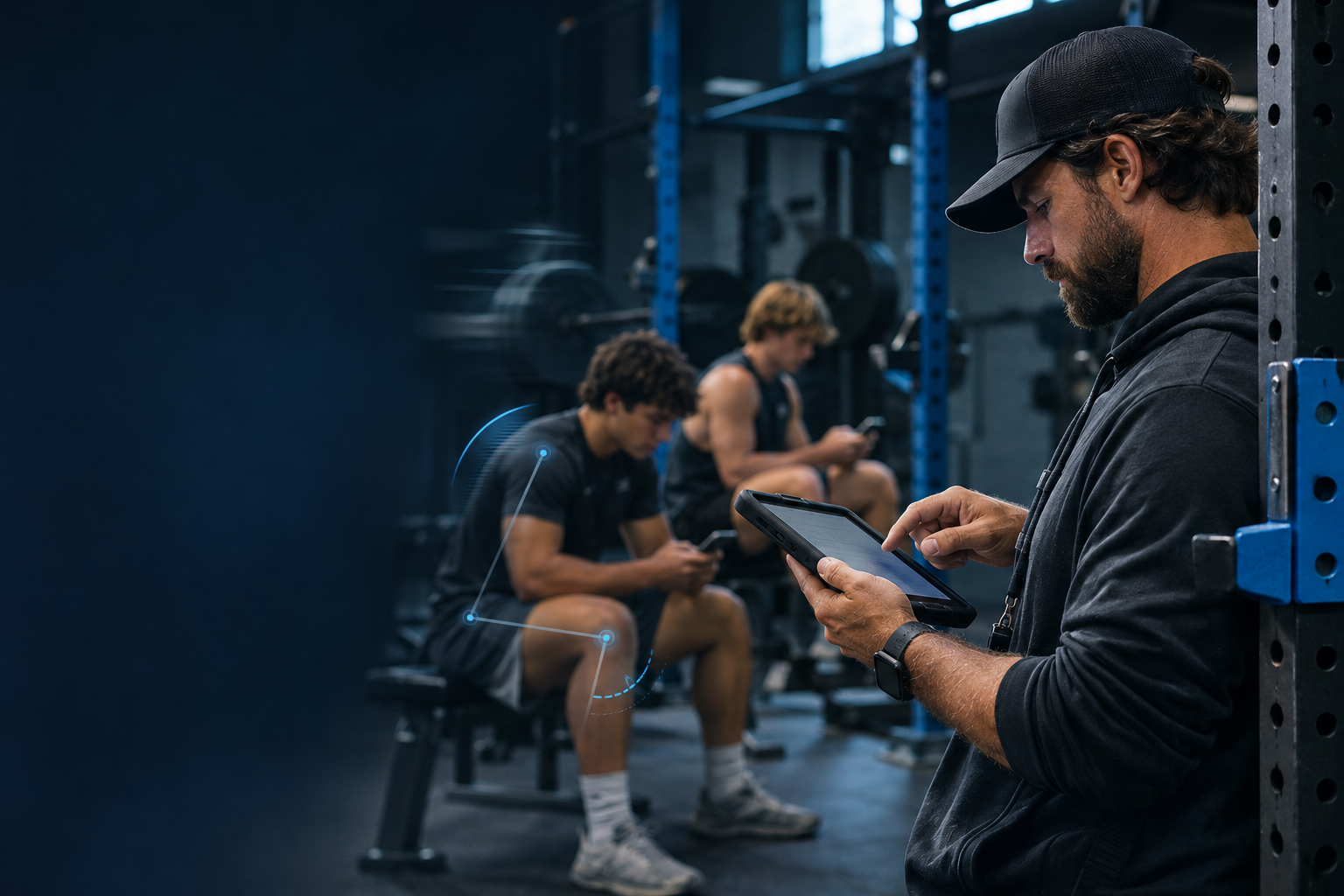
Search for an athlete training system and you get a mess. Vendor homepages. Coaching essays about training philosophy. A couple of forum threads asking the same question you just asked. Almost nothing that tells you what the category is or how to judge one.
That gap matters, because the decision is sticky. Once a program loads two seasons of training into a platform, it tends to stay there. The switching cost is the data, not the subscription.
This is the buyer's version of the question. What the category actually is, the six jobs a system has to do, the five kinds of system on the market, what the data layer should collect, the privacy duty most buyers skip, and a trial protocol you can run in one afternoon.
What an athlete training system is
An athlete training system is the software a program uses to write training, deliver it to athletes, and collect what came back. Three parts, one loop. A coach builds the program, athletes see it on a phone, and the work they did flows back as data the coach can act on.
That last part is what separates a system from a document. A PDF program delivers training. It does not tell you who did it.
The category gets confused with three neighbors, and the confusion is expensive. All three are built and priced differently.
A personal training app is built around one coach and one paying client. Billing, packages and client acquisition sit at the center. It handles a roster of twelve individuals well and a roster of eighty teenagers badly.
An athletic training record system is clinical. It documents injuries, treatments and return-to-play decisions. That is a different category with different buyers and different legal weight. A training system should not be asked to hold clinical notes, and a record system will not write your offseason block.
A wearable or sensor platform collects measurements. Heart rate, GPS distance, bar velocity, jump height. It is a data source, not a programming layer. Some of them have bolted a programming tab on. Check whether it was built or bolted.
The six jobs a system has to do
Every athlete training system is some combination of six jobs. Rank them for your situation before you watch a single demo. A platform that is excellent at four of them and useless at the two you care about is the wrong platform, however good the demo looked.
Programming. Writing the training and reusing it. The thing to test is not whether you can build a session. It is whether you can build a twelve-week block once and then run it for three teams with different loads. Weak programming shows up as copy-paste work every Sunday night.
Delivery. Getting today's session in front of the athlete with no friction. On a phone, in a weight room, on bad wifi. Weak delivery shows up as athletes asking what they are doing today.
Data capture. What came back. Completion, loads, reps, how it felt. This is the job most often oversold and under-delivered, because capture depends entirely on whether athletes will actually log. Weak capture shows up as a dashboard full of blanks.
Monitoring. Turning the captured data into something you notice. A trend line, a flag, a name at the top of a list. Weak monitoring shows up as data you have but never look at.
Communication. Coach to athlete, coach to coach, and sometimes coach to parent. Weak communication shows up as the whole program running through a group text anyway, which means the system is already half abandoned.
Administration. Rosters, permissions, who sees what, and getting athletes on and off the system as seasons turn. Boring and decisive. Weak administration shows up every August.
The five categories of system
Products get renamed and repositioned constantly. Categories do not. Work out which of these five you are shopping for and the field narrows fast.
| Category | Who it fits | What it does well | Where it breaks | Typical cost shape |
|---|---|---|---|---|
| Spreadsheet and PDF stack | One coach, a handful of athletes, training that changes slowly | Free. Infinitely flexible. No learning curve for the coach | No data comes back. Version control fails the moment two coaches edit. Unusable above about fifteen athletes | Free, paid for in hours |
| Personal training app | A trainer with paying individual clients, online or in person | Billing, client onboarding, individual programming, habit and nutrition tracking | Team structures, large rosters, school permissions, anything priced per athlete at scale | Monthly per coach, often with a client-count tier |
| Team programming platform | A coach or small staff running the same block across one or several teams | Write once and assign widely. Weight-room delivery. Completion tracking | Thin on monitoring and reporting. Often no place for screening or wellness data | Monthly or annual per team, sometimes per athlete |
| Athlete management and monitoring platform | A program with multiple coaches, an athletic trainer, and someone whose job is to read the data | Load and wellness monitoring, reporting, cross-team visibility, permissions | Setup cost is real. Needs a named owner or the data goes stale. Overbuilt for a single team | Annual contract, usually per athlete with a floor |
| Sensor or hardware-first platform | Programs already committed to a measurement method and staffed to use it | High-quality objective measurement of the thing it measures | Programming is usually an afterthought. Data arrives faster than anyone can interpret it | Hardware up front plus a software subscription |
Most buying mistakes are category mistakes, not product mistakes. A high school that buys a personal training app because the demo was slick spends a year fighting the roster model. A single coach who buys an athlete management platform spends a year paying for depth nobody has time to use.
What the data layer should actually collect
The most useful data in an athlete training system is also the cheapest to collect. It is what the athlete tells you. That tends to surprise people who came in expecting to shop for sensors.
A systematic review of fifty-six studies that measured athlete well-being both ways found something awkward for the hardware industry. Self-reported measures tracked both acute and chronic training load with better sensitivity and consistency than objective measures did. The two kinds of measure also did not reliably agree with each other. Objective measures were generally unresponsive to short-term changes in load. Short questionnaires were not.
So the first thing to check is whether the system has a daily athlete check-in, and whether it takes under fifteen seconds on a phone.
The questions matter too. The items that responded to both acute and ongoing load were fatigue, physical recovery, general health and well-being, feeling in shape, and stress from outside training. The same review named sleep quality and confusion among the items that were unresponsive. Rolling the answers up into a single wellness score typically made the measure less sensitive, not more. A system that shows you one green-amber-red number per athlete has thrown away the signal.
The second cheap input is session effort. Asking an athlete to rate how hard a session was, then multiplying by its duration, gives you an internal load number. Pooled validation work across sports, ages and ability levels found this method valid and reliable enough to stand on its own, although some researchers prefer to pair it with heart rate. One question after practice. No hardware.
Third is completion and load logging. Which sessions happened, what was lifted, how many reps. Mundane, and the foundation of everything else. Progressive overload is not a philosophy if nobody wrote the numbers down.
Objective measurement comes after that, not before. Sensor data is genuinely useful when there is a person whose job is to read it and a decision it feeds. Bar velocity is a good example of a metric with real uses and real prerequisites. If nobody on staff has the time to interpret it, buying the device buys you a spreadsheet nobody opens.
One caution on how this data gets sold. Monitoring produces information for decisions. It does not by itself reduce injuries, and any vendor who promises it will is overselling. Injury and rehab decisions belong with a physical therapist or physician, and a software dashboard is not a clinical judgment.
The privacy question most buyers skip
The privacy question is whether your vendor's database counts as a school record, and for most school buyers it does. That is the detail which decides whether the purchase survives review. It is also absent from almost everything written about this category.
Under federal student privacy law, education records are records directly related to a student that are maintained by the school or by a party acting for or on behalf of the school, and at the K-12 level that definition explicitly includes health records. Read the second half of that sentence again. The vendor's database is the school's record.
Which means the questions below are not paranoid. They are the ones your district will ask you after you have signed.
- Who owns the data? The contract should say the school does, in those words.
- Can you export all of it, in a readable file format, at any time and after termination?
- Which subprocessors touch the data, and where is it stored?
- What is the breach notification commitment, and how fast?
- What is the retention and deletion policy when an athlete graduates?
- Is the data used to train models or build aggregate products, and can you opt out?
A vendor who has done this before will answer in a paragraph, not a meeting. The Department of Education publishes a resource set aimed specifically at education technology vendors handling student information. A company in this market has no excuse for being unfamiliar with the obligations. If the answers are vague, that is your answer.
Club and private programs are not covered by the same statute. The practical questions are identical. Parents increasingly ask them. Ask any vendor the six questions above in writing, including us, and start with Greater's notes for schools and athletic programs if a school program is what you are buying for.
How to evaluate one in an afternoon
Evaluate a system on the two things a demo never shows. How many of your own minutes it costs per week, and what happens when the data is messy or missing. Run this on a trial with real training and a stopwatch.
- Rebuild a block, not a session. Take four weeks of training you have already written and enter all of it. Time the whole thing. That number, multiplied by how many distinct groups you program for, is what one programming cycle costs you. Multiply again by the number of blocks you write in a season and you have the real annual bill.
- Then change one exercise in week three. See whether the change propagates everywhere it should, or whether you have to make it four more times. Propagation is the entire value of a programming layer, and it is the feature demos skip.
- Assign that block to a second group at different loads. If this is a rebuild rather than a copy, the system does data entry, not programming.
- Break it on purpose. Have an athlete log the wrong load, then fix it yourself as the coach. Correcting bad data is a weekly job for the rest of the season. If it takes six taps, you will stop doing it, and then the data is worse than none.
- Look at the coach view with half the roster missing. In November, half your roster will not have logged. A view that only reads well at full compliance is a view you will never use.
- Price the exit before you price the subscription. Ask what your data looks like on the way out, in what format, and what happens to it ninety days after you stop paying. The answer tells you how confident the vendor is.
- Ask for the renewal number in writing, against the athlete count you expect in year two. First-year pricing is a marketing decision. Year three is the real price.
- Add an athlete and remove an athlete. August will thank you.
Run that on two systems and the decision usually makes itself. One of them will have been faster on step one and honest on step seven.
What you can skip
Feature lists are written to win comparisons, not seasons. At small-program scale these are the ones that reliably go unused.
Executive dashboards, if there is nobody whose job includes opening them. Wearable integrations, if there is nobody to interpret the output. In-app payments, if your athletes are students and the money moves through the district. Enormous exercise video libraries, if your coaches already demonstrate in the room. Parent portals, unless parents have actually asked.
There is a sharper version of this rule. Every feature that adds a tap to logging costs you data. The data layer is the whole asset, and athletes build it, unpaid, while tired. Judge features by whether they make logging faster or slower. A surprising number of impressive ones make it slower.
Still working out which shape of product you need? We have broken down the five kinds of athletic app and the four jobs coaching apps actually do elsewhere, and both include feature checklists worth reading alongside the timing protocol above.
Matching the system to your program
One coach, under fifteen athletes, training that changes slowly. You may not need software yet, and anyone telling you otherwise is selling. The trigger to buy is not roster size, it is the first time you cannot answer who did the work. Notes for individual coaches if that is where you are.
One coach, multiple teams. This is where a team programming platform earns its money immediately. Write once, assign widely. Prioritize programming reuse and delivery over monitoring depth, because you will not have time to read deep monitoring anyway.
Multiple coaches plus an athletic trainer. Now administration and permissions move to the top of the list. Monitoring becomes worth paying for, because somebody will actually read it. Keep the clinical records separate from the training system. Different category, different duty of care.
Across all three, the same test applies at renewal as at purchase. Is the data coming back? If the logging stopped in October, you are paying for a delivery mechanism, and a shared folder does that for nothing.
Running the protocol on Greater
If you want a second system to run the protocol against, run it here. Load one real training week, assign it to a group, and time the steps above on your own program rather than on a demo.
Want to run the afternoon protocol on something?
Greater assigns the block to every athlete, delivers it to their phone, and tracks completion so you can see who did the work without having to ask. Load one real training week and judge it on your own program. Our pricing is published, which is itself worth checking on any system you evaluate.
Try Greater freeFrequently asked questions
What is an athlete training system?
It is the software a program uses to write training, deliver it to athletes, and collect what came back. The third part is what makes it a system rather than a document. A PDF program delivers training but tells you nothing about who did it, at what load, or how it felt.
How is an athlete training system different from a personal training app?
A personal training app is built around one coach and one paying client, so billing, packages and client acquisition sit at the center of the product. An athlete training system is built around rosters, teams and shared programming. The practical difference shows up at scale and in permissions. A personal training app handles twelve individual clients well and eighty high school athletes badly.
Do I need one if I only coach a single team?
Possibly not yet. Under about fifteen athletes with training that changes slowly, a well-kept spreadsheet is defensible. The trigger to buy is not roster size. It is the first time you cannot answer who actually did the work, or the first time two people editing the same program causes a problem.
What should an athlete training system cost?
Pricing in this category follows one of three shapes. Per coach per month, common for products aimed at individual trainers. Per team, annual or monthly, common for team programming platforms. Per athlete on an annual contract with a minimum, common for athlete management and monitoring platforms. The shape matters more than the headline number, because it determines what happens to your bill when the program grows. Ask for the renewal price, not just the first-year price.
Who owns the data if we stop paying?
Make the contract say it is yours, explicitly, and confirm during the trial that you can export everything in a readable file format without contacting support. For a school there is a further point, covered with its source in the privacy section above: records a vendor maintains on the school's behalf can sit inside the federal definition of education records. Ask about retention and deletion when athletes graduate before you sign, not after.