

Balance Exercises for Athletes: The 6-Week Progression
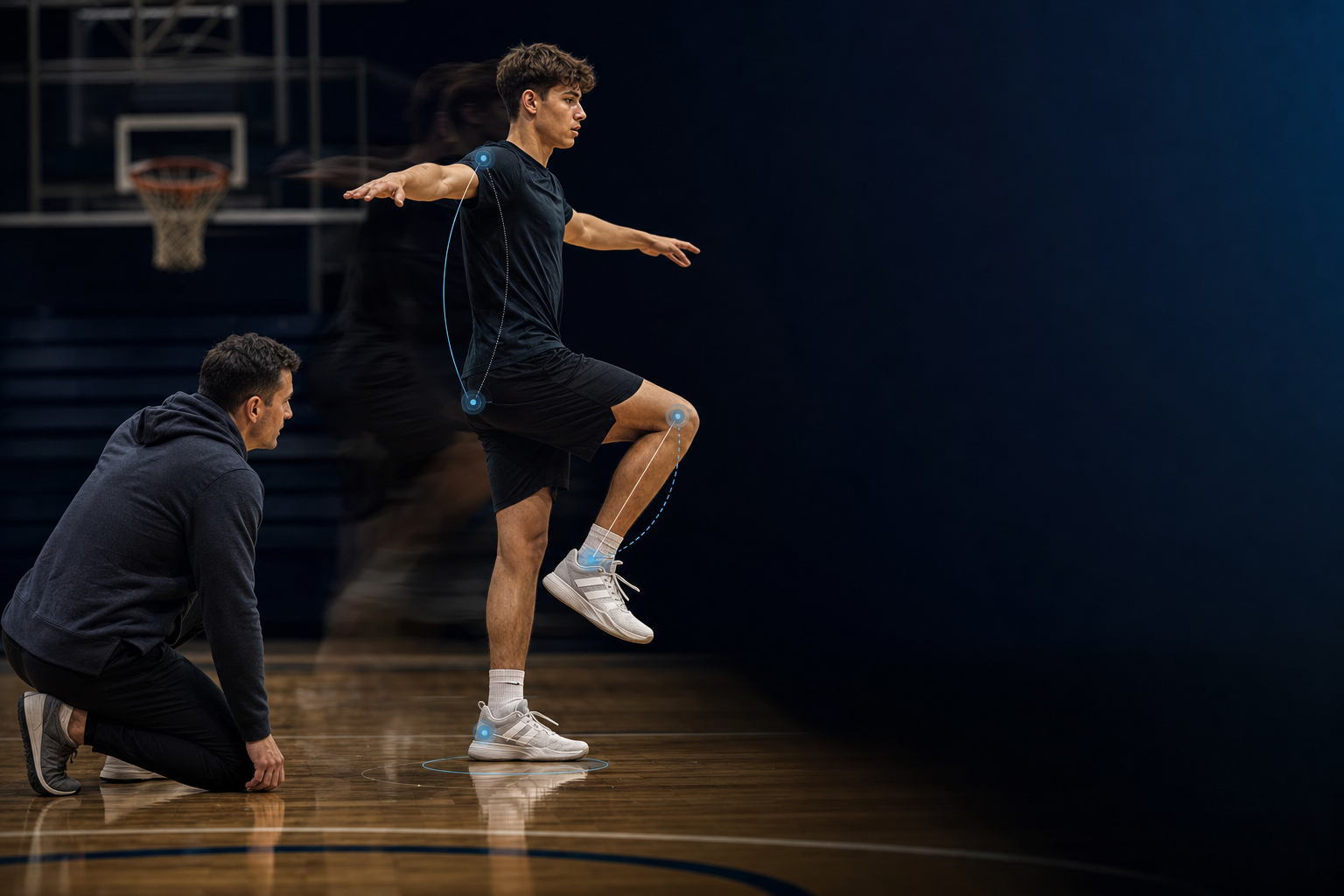
Search for balance exercises for athletes and you get a list. Six movements, eight movements, a photo of each one. Nobody tells you how many weeks to run them, how hard they should feel, or how to know whether they did anything.
That is the gap this article fills. Twelve exercises in three tiers, a six-week progression, and two measurements you take before you start and again at the end.
The short answer
Balance training for athletes means progressive single-leg work under increasing instability and increasing speed. You start slow and stable. You finish fast and unpredictable.
The working dose is roughly 10 to 15 minutes, two or three times a week. A review of balance training dose-response in healthy young adults supports 11 to 15 minutes per session and three sessions a week, and found the largest effects in elite athletes. It also points to a longer program than most coaches run, 11 to 12 weeks for the best results on steady-state balance. Six weeks is the shortest block worth measuring, not the end of the job.
It works on the thing it trains. Pooled across trials in young athletes, neuromuscular training improved both static and dynamic postural stability with large effect sizes. What it does to injury rates is a narrower claim, and the next section covers it honestly.
What balance training actually does, and what it does not
Almost every page ranking for this keyword says balance exercises prevent injuries. The trial evidence is more specific than that, and the specifics change who you should run the program on.
The clearest single trial randomized 765 high school soccer and basketball players to a balance training program or to standard conditioning. The sprain rate was 6.1 percent in the balance group and 9.9 percent in the control group.
Across the whole intervention group, doing the program roughly halved the risk of a sprain. The benefit was not spread evenly. In athletes with no previous sprain the difference did not reach statistical significance, and a previous sprain roughly doubled the risk on its own. So the effect you can lean on sits with the athletes who already have a history.
A second trial backs that up. Athletes with a previous sprain ran an unsupervised balance-board program at home for eight weeks. Over the following year, recurrences fell from 33 percent to 22 percent.
Pooled across athlete populations, balance training sits at roughly half the ankle sprain risk of no training at all. An evidence review of proprioceptive training found a reduction in repeat sprains in athletes who already have a history, a little over a third.
The honest summary. Balance training reliably improves measured balance. It reduces ankle sprain risk, most clearly in athletes who have sprained an ankle before. It does not prevent injuries and nothing in the research claims it does.
One more thing worth knowing. The same review found bracing came out with a lower relative risk than balance training for ankle sprains specifically. Read that carefully. The two were pooled from different sets of trials against separate controls, not compared head to head, and no trial in the review tested doing both. It is not an argument against training. It is a reason to put a brace on an athlete with a history as well, which is covered in the full ankle injury prevention program.
Test first: the two measures worth taking
Take these two measurements before week one. Budget five to six minutes per athlete. Without them you have no way to tell the difference between a program that worked and six weeks of standing on one leg.
Measure 1: single-leg stance, eyes closed
Barefoot or in socks. Hands on hips. Stand on one leg, free foot off the floor and not touching the standing leg. Close the eyes and start the clock. Stop the clock when the hands leave the hips, the free foot touches down, or the standing foot moves. Stop the test altogether if the athlete reports pain or the ankle or knee gives way. Send that athlete to a physical therapist or physician rather than recording a number. Two attempts per leg, record the better one. Cap it at 45 seconds.
This is not an arbitrary drill. In high school basketball players, those with poor single-leg balance in preseason testing went on to have a far higher ankle injury rate than those with good balance. Treat a short time, or a big gap between legs, as the thing to work on.
Measure 2: anterior reach
Put a tape measure on the floor. The athlete stands on one leg with the toe at zero. They reach the free foot forward along the tape as far as they can, touch lightly, and come back under control without putting weight on it. No heel lift on the standing foot. Three attempts per leg, record the best in centimeters.
Two reasons to use this direction. Every direction in the reach-test family tests out as reliable, and the anterior reach is the one you can run with a tape measure on a gym floor and nothing else. Reach performance in this test family is also related to lower extremity injury risk and to post-injury deficits.
Read the difference, not the number. Absolute reach distance varies with leg length and does not mean much on its own. The four centimeter gap is where the threshold comes from: in high school basketball players, a right-left anterior reach difference above four centimeters came with about two and a half times the odds of a lower extremity injury.
Hold that number loosely. Later work in college athletes did not reproduce the four centimeter cut-off, landed on different thresholds for each reach direction, and found that none of them separated the athletes who got hurt from the ones who did not with any precision. Use the gap as a flag for which leg to give extra sets to, not as a verdict.
Same tester both times. One tester repeating themselves and two testers swapping in both test out as reliable in the research, so this is not about the statistics. It is about drift. Foot placement, the touch-down cue, and how strictly you call a weight shift all vary between people, and you are comparing two numbers six weeks apart. Keep one person on the clipboard. If you want a wider picture of movement quality than two balance measures, a broader movement screen covers more ground.
The twelve exercises, by tier
Three tiers. Tier 1 is static and slow. Tier 2 adds movement. Tier 3 adds unpredictability and speed. You need a line on the floor, a ball, and optionally a foam pad or balance disc. Nothing else.
| Exercise | Tier | What it loads | Reps or time | Progress when |
|---|---|---|---|---|
| Single-leg stance, eyes open | 1 | Ankle and hip stabilizers, basic postural control | 3 x 30 sec per leg | 30 seconds is comfortable with a quiet foot |
| Single-leg stance, eyes closed | 1 | Same, with vision removed so the ankle and hip do more | 3 x 20 sec per leg | 20 seconds with no hop or hand reach |
| Single-leg stance on a foam pad | 1 | Ankle stabilizers on an unstable surface | 3 x 20 sec per leg | The foot stops searching for the floor |
| Tandem stance walk, heel to toe | 1 | Side-to-side control and foot placement | 3 x 10 steps | Ten steps in a straight line without stepping off |
| Single-leg reach, forward and diagonal | 2 | Hip control through range, the pattern the anterior reach test uses | 3 x 6 per direction per leg | The reach is smooth and the knee stays over the foot |
| Single-leg deadlift, bodyweight | 2 | Hamstring and glute control of a moving hip | 3 x 8 per leg | Hips stay level through the whole rep |
| Lateral hop to single-leg stick | 2 | Landing control going sideways | 3 x 6 per leg | You can stick the landing for two seconds with no wobble |
| Walking lunge with a pause at the bottom | 2 | Control through a long base, both legs | 3 x 8 per leg | The pause is genuinely still |
| Single-leg hop in four directions | 3 | Reactive control changing direction | 3 x 8 hops per leg | Landings are quiet and the knee tracks over the foot |
| Partner ball toss on one leg | 3 | Balance while attention is somewhere else | 3 x 30 sec per leg | You can catch without looking at the standing foot |
| Single-leg stance with a head turn or partner nudge | 3 | Reacting to a push you did not plan for | 3 x 20 sec per leg | A light nudge no longer moves the foot |
| Cut and stick off one leg | 3 | Deceleration and plant, the pattern most sports actually use | 3 x 6 per leg | You are ready to put it into drills at practice speed |
Quiet is the coaching cue that does most of the work here. A noisy landing is a stiff landing. A foot that keeps searching is a foot that is not controlling anything yet.
Hold the progression rules. An athlete moves up a tier when they meet the progress condition on every exercise in the tier they are on, not when the calendar says so.
The six-week progression
This is the program. Three sessions a week in the offseason, two in-season. Ten to fifteen minutes each.
| Week | Tier mix | Session | Per week | Surface and speed | Added challenge |
|---|---|---|---|---|---|
| 1 | Tier 1 only | 10 min | 3 | Firm floor only, slow and deliberate | None. Learn the positions and the test stop rules. Hold the foam pad exercise until week 2. |
| 2 | Tier 1, eyes closed emphasis | 10 min | 3 | Firm floor, plus the foam pad exercise | Vision removed on the stance drill, and on the foam pad drill once the foot is quiet. |
| 3 | Two tier 1 exercises plus two tier 2 exercises | 10 min | 3 | Firm floor, controlled movement | The hip starts moving through range. |
| 4 | Tier 2 led, one tier 1 warm-up | 12 min | 3 | Firm floor, add the sideways hop | Landing control, sticking a hop for two seconds. |
| 5 | Tier 2 plus two tier 3 exercises | 15 min | 3 (2 in-season) | Firm floor, practice speed on the hops | Reactive work. A partner, a ball, or a head turn. |
| 6 | Tier 3 led, one tier 2 warm-up | 15 min | 3 (2 in-season) | Practice speed, then retest at the end of the week | Cut and stick. Then the week-6 retest, same tester. |
Why six weeks and not two. Six weeks is the shortest block that gives the measurements room to move for reasons you can trust. It is a floor, not an optimum. The dose-response work on balance training points to 11 to 12 weeks and at least 16 to 19 sessions for the best results on steady-state balance. So treat the six weeks as the first block and the retest as a checkpoint, not a finish line. The maintenance session below is what keeps the gain.
In-season variant: two sessions a week, 8 to 10 minutes, folded into the warm-up before practice. Drop week 1 and start at week 2, because in-season athletes are already moving daily. Hold tier 3 until a lighter practice week.
Offseason variant: run it exactly as written, three sessions a week, as the first block of the training year. Then keep one maintenance session a week once the retest is done.
The ten-minute session, exercise by exercise
Here is week 3 written out, because week 3 is the first session where both tiers are in play. Four exercises, two from tier 1 and two from tier 2. Run it before lifting or before practice, never after heavy fatigue.
- Minutes 0 to 2. Single-leg stance, eyes open, 1 x 30 seconds per leg, then straight into the next block. This is the warm-up, not the work. Hands on hips, quiet foot.
- Minutes 2 to 5. Single-leg stance, eyes closed, 3 x 20 seconds per leg. Open the eyes the moment the foot touches down, reset, continue. Count the resets.
- Minutes 5 to 8. Single-leg reach, forward and diagonal, 2 x 6 per direction per leg. Knee over the foot. Touch light, do not transfer weight.
- Minutes 8 to 10. Single-leg deadlift, bodyweight, 2 x 6 per leg. Hips level. Slow down and slow back up. If the reps start getting quick to fit the clock, cut a set rather than the tempo.
Two sets here, not the three in the library. Three sets is the week 5 and week 6 target, once the session is 15 minutes. Rest is whatever the other leg takes. There is no need to sit down between sets at this volume.
Sport-specific tweaks
The twelve exercises do not change by sport. The tier 3 emphasis does.
Basketball
Weight the single-leg landing work. Rebounds and layups both finish on one leg, often with contact. Bias the four-direction hops toward backward and lateral, which is where a contested landing usually goes.
Soccer
Weight the cut and stick. The planted foot is where the demand lives, both on changes of direction and on the leg that stays down when the other one strikes a ball. Add the partner nudge, because contact arrives while the foot is planted.
Volleyball
Weight the single-leg takeoff and landing. Approach jumps and blocks both land asymmetrically, often while looking up and away from the floor. The ball toss on one leg is the closest match in the library.
Running sports
Weight midstance control. Watch for the hip dropping on the standing side during the single-leg deadlift and the reach. That is the pattern to chase rather than longer static holds. If you want to see what is happening at the ankle and knee frame by frame, a phone video tells you more than a stopwatch.
Where balance training belongs in the training week
Before the hard work, not after it. Balance training is a quality exercise. Tier 3 reactive work done tired is just a way to collect a sprain.
Placement, in order of preference. First choice is the warm-up before lifting or practice, after the general movement prep. Second choice is a standalone ten-minute slot on an off day. Last choice is the end of a session, and only for tier 1 work.
It does not replace strength training. Single-leg control without the strength to hold a position is a short-lived improvement, which is why this block sits inside a full strength and conditioning program rather than next to one.
Retest at week 6, and what each result means
Same two measures. Same tester. Same time of day and same footwear if you can manage it. Then use this table.
| Retest result | What it means | What to do next |
|---|---|---|
| Both measures improved, legs within about 4 cm of each other on the reach and a few seconds on the stance | The block did its job and the asymmetry closed | Move to maintenance. One tier 3 session a week. Retest in 12 weeks. |
| Measure 1 was already at the 45 second cap at week 0 | The stance test has no room left to improve, so it cannot answer the question for this athlete | Judge this athlete on the reach test and the left-right gap. Next block, run the stance test on a foam pad so there is somewhere to go. |
| Measures improved but one leg is still clearly behind | Training worked, the asymmetry needs more time | Run weeks 3 to 6 again with extra sets on the weaker leg only. Retest after four weeks. |
| Little or no change, and sessions were missed | An adherence problem, not a program problem | Fix the slot before changing the program. Same six weeks, counted this time. |
| Little or no change, and sessions were completed | The progression probably stayed too easy, unless a measure was already at its cap | Rerun from week 3 and hold the surface and speed progressions strictly. Advance only on the stated condition. |
| Measures went backward, or there is pain, swelling, or a joint giving way | This is not a training question | Stop the balance work on that limb and refer the athlete to a physical therapist or physician. |
One honest caveat on the retest. These measures tell you whether balance improved. They do not tell you whether an injury was avoided, and no test an athlete can do in a gym will tell you that.
If you want the before and after on video rather than on a clipboard, Greater's AI movement analysis reads a phone video of a single-leg hold or landing, so you have the same read at week 0 and at week 6. See how it works.
Why balance programs fail on a team
The program is not usually the problem. Adherence is.
In a cluster-randomized prevention trial across 920 high school basketball players, self-reported compliance with the home-based training was 60 percent. That is a funded trial with blinded assessors tracking every athlete. A squad doing it on trust will do worse.
Three fixes, in order of how much they matter.
- Make it the warm-up. A block that happens before practice happens. A block assigned as homework does not.
- Name an owner. One assistant, one captain, one person who runs the ten minutes. Shared responsibility means nobody starts the clock.
- Check completion instead of assuming it. The gap between what you assigned and what got done is the whole ball game, and you cannot close a gap you are not measuring.
That last one is a tooling problem more than a coaching problem. Greater assigns the session to each athlete, lets them mark it done, and shows you who actually did it, with messaging to chase the ones who did not. See the platform.
The bottom line
Test single-leg stance with eyes closed and anterior reach before you start. Start static, finish reactive. Advance on the condition, not the calendar. Retest with the same tester at week 6, then keep a maintenance session going, because six weeks is the floor and not the ceiling.
The athletes who will get the most out of it are the ones who have already sprained an ankle. That is where the evidence is least ambiguous and where the program is easiest to justify to a coach protective of practice time.
If an athlete has pain, swelling, or a joint that gives way, that is a referral to a physical therapist or physician, not a reason to add a balance exercise.
Frequently asked questions
How long until balance training works?
Plan on at least six weeks before a retest shows anything you can trust. Treat six weeks as a floor rather than an optimum. The dose-response research on balance training points to 11 to 12 weeks and at least 16 to 19 sessions for the best results, so the first block is a checkpoint and not a finish line. Over two or three weeks the measurement cannot separate a real change from ordinary day-to-day variation.
How often should athletes do balance exercises?
Three sessions a week fits the offseason, when the session can be a standalone block of 10 to 15 minutes. Two a week fits in-season, folded into the warm-up before practice, at 8 to 10 minutes. The sessions are low enough in volume that they do not need a recovery day between them.
Do balance boards and wobble cushions help?
Yes, as one progression among several. A home balance-board program in athletes with a previous ankle sprain reduced recurrences over the following year. But the board is a way to make a position harder, not a magic surface. A foam pad, closing the eyes, moving faster, or adding a partner nudge all do the same job, and the last two are closer to what a sport actually asks for.
Do balance exercises prevent ankle sprains?
No. They reduce risk, and the size of the reduction depends on who is doing them. In a randomized trial of high school soccer and basketball players, the balance group had a lower sprain rate than the control group, and doing the program roughly halved the risk across the whole intervention group. For athletes with no previous sprain, the difference did not reach statistical significance, so the effect you can lean on is in athletes who already have a history. Nothing eliminates sprain risk, and any program that claims to is overstating what the research supports.
Can balance training be done in-season?
Yes, and in-season is where it is easiest to sustain, because it fits inside the warm-up. Use two sessions a week of 8 to 10 minutes, skip the first week of the progression since in-season athletes are already moving daily, and hold the reactive tier-3 work for lighter practice weeks. Doing it before practice rather than after is the part that matters most.