

How to Prevent Hamstring Cramps (It's Usually Not an Electrolyte Problem)
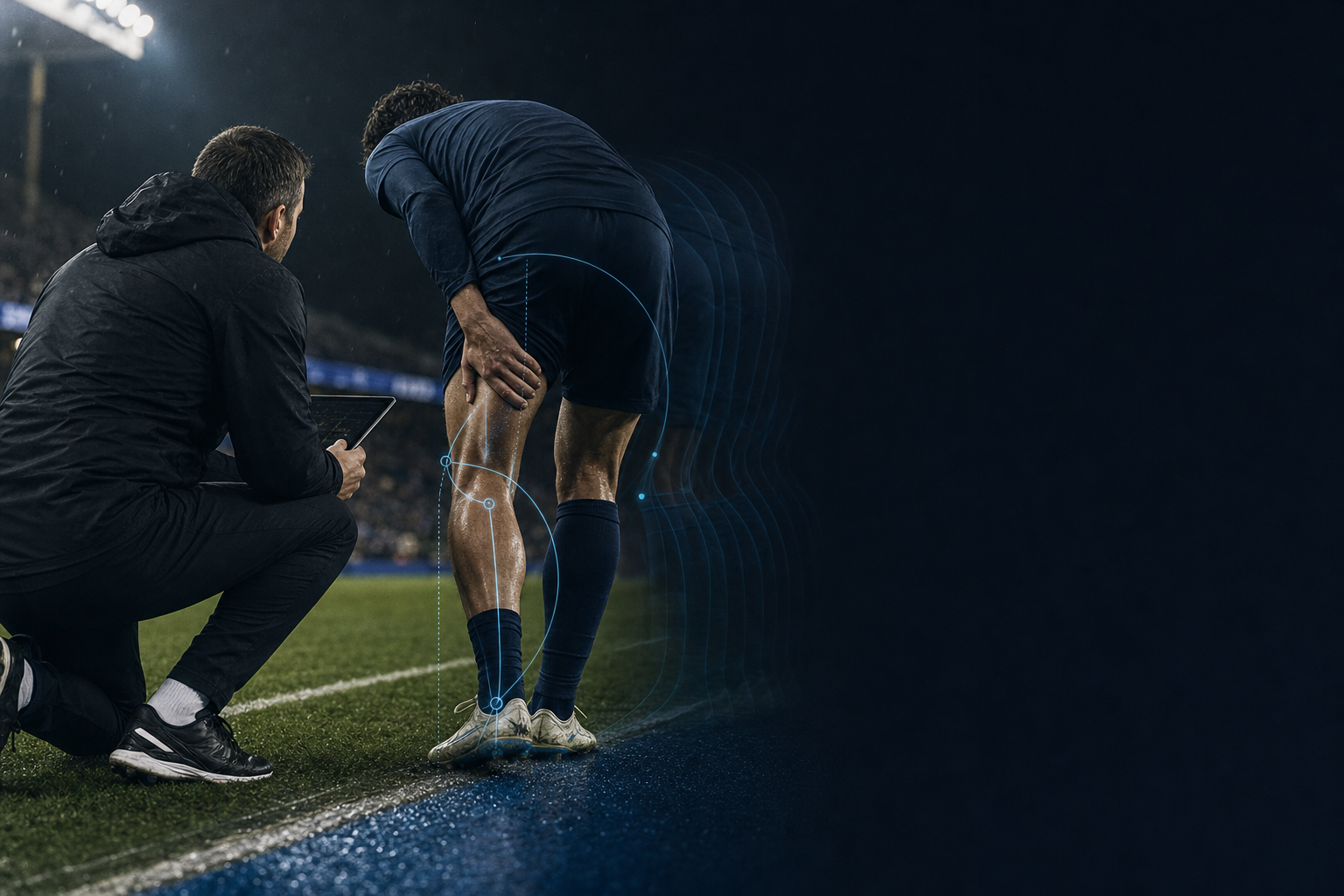
What actually causes a hamstring cramp during training
An exercise-associated muscle cramp is a sudden, involuntary, painful contraction of a muscle during or shortly after exercise. The hamstring is one of the most common sites, especially late in a hard session, a match, or a meet. For years the standard explanation was simple. You ran low on fluids or electrolytes. A comprehensive review of the current evidence does not back that up as the whole story.
That review favors a different mechanism: altered neuromuscular control driven by fatigue. In plain terms, a tired muscle starts sending confused signals between the muscle spindle and the spinal cord. The reflex loop that normally keeps a contraction under control misfires, and the muscle locks down instead of relaxing. The result is an involuntary contraction that will not release on its own until the signal resets, usually through stretching. This matters for prevention. If fatigue is the main driver in most cases, fixing hydration alone will not fix the cramp problem for most athletes.
That does not make dehydration irrelevant. It is a real risk factor. It is just not the dominant one the current evidence points to, and treating it as the only lever leaves the bigger lever, training fatigue, untouched.
Why "just drink more fluids" keeps showing up (and why it is not the whole picture)
Search for hamstring cramps and nearly every result leads with hydration and electrolytes. That advice is not wrong on its own terms. It is incomplete, and it does not explain the pattern coaches actually see.
Athletes cramp in cool gyms with full water bottles sitting next to them. Athletes cramp late in a lift, a set, or a match, not early, when hydration status has barely changed from the start of the session. That pattern fits a fatigue-driven cramp far better than a fluid-deficit one. The same review walks through both theories side by side and explains why altered neuromuscular control currently has the stronger case, while noting that no single theory explains every cramp.
Heat and hydration still matter, and dismissing them would be its own mistake. An athletic trainers' standards body's guidance on preventing heat-related illness in sport recommends gradual heat acclimatization over 7 to 14 days, planned hydration, and adjusting training intensity and duration to the conditions on the day. Treat that as one real layer of prevention, not the whole plan, and definitely not the explanation for a cramp that happens in a 60-degree gym in November.
Which sports and moments see this most
Hamstring cramps are not evenly distributed across a season. They cluster at predictable points, and knowing the pattern is most of the prevention work.
Field-sport athletes tend to cramp in the final quarter of a match, when conditioning debt from the whole game has accumulated. Runners tend to cramp late in a long effort or a race, past the point their normal training volume covers. Powerlifters and strength athletes tend to cramp on heavy, high-effort singles and doubles, especially on deadlift and squat variations late in a session or on meet day itself. Adrenaline, a longer-than-usual day on your feet, and near-maximal effort all stack on top of each other at exactly that moment. That last pattern is one I see constantly with my own athletes around meet day. It responds to the same fix as every other version of this problem: build the specific conditioning and manage the taper, rather than hoping a sports drink covers it.
The risk factors that actually predict who cramps
Prevention works better when it targets an athlete's actual risk factors instead of a generic checklist handed to the whole team. The review frames prevention this way directly: individualized and risk-factor-based, not one-size-fits-all.
| Risk factor | Why it raises risk | What to adjust in training |
|---|---|---|
| A sudden jump in training load | Fatigue builds faster than the muscle adapts to it | Progress volume and intensity in smaller steps, especially after a break, an off-season, or a layoff |
| A history of cramping | Past cramps predict future ones more reliably than any single lab marker | Flag these athletes for closer load monitoring, not just more water on the sideline |
| Heavy late-session or late-game fatigue | Cramps cluster in the last portion of a session, match, or meet, not the first | Build conditioning specific to that point in the session, not just general fitness |
| Hot or humid conditions | Heat adds a second load on top of training fatigue, even when it is not the main cause | Acclimatize gradually over 1 to 2 weeks and adjust session length and intensity to conditions |
| Little or no taper before competition | Carrying high accumulated fatigue into a game or meet raises risk at the exact moment it matters most | Plan a real taper window, not just one lighter single session the day before |
Conditioning that lowers cramp risk, step by step
The practical fix is not a supplement or a pre-workout mix. It is conditioning that matches the actual demand of the sport, built up gradually enough that athletes are not freshly fatigued at the exact point in a session where they have cramped before.
Three things matter most, in order. First, progress training load in small steps rather than big jumps, especially coming back from an off-season, a tournament break, or an injury layoff. A week-to-week volume jump is a much better predictor of cramping than anything in a water bottle. Second, build conditioning specific to the part of the session or game where cramps tend to show up. If an athlete always cramps in the fourth quarter, the fix is conditioning work that simulates fourth-quarter fatigue, not more general aerobic base. If a lifter cramps on meet-day deadlifts, the fix is practicing heavy, fatigued singles in training, not just more total volume. Third, give athletes a real taper before competition instead of asking them to peak and compete in the same week. A short, planned reduction in volume lets accumulated fatigue clear before the moment that matters.
A real taper does not have to be complicated. A simple version looks like this. Hold volume steady until roughly 10 to 14 days out. Cut total volume by about a third while keeping intensity high for the next week. Then cut volume again in the final few days, keeping the movements the body is used to. The goal is to arrive at competition with accumulated fatigue cleared, not with a body that has forgotten what hard work feels like.
One more factor worth tracking separately: athletes who play more than one sport, or who move between a school team and a club team in the same week. They often carry far more total load than either coach can see on their own. A cramp that looks random to the school coach can be the predictable result of a club practice the night before. This is one more reason a cramp history and a load log need to travel with the athlete, not live in one coach's notebook.
Be honest with athletes and parents about what this buys you. Good conditioning and a sensible taper reduce cramp risk. They do not guarantee a cramp-free season or a cramp-free meet, and no program, ours included, can promise that.
Schools and club programs running this across a full roster with a small coaching staff tend to build the taper plan once, for the group, then adjust the timing for individual athletes coming back from a layoff or carrying a heavier outside load.
What to do when a hamstring cramps mid-session
Stop the activity immediately. Do not try to finish the rep, the sprint, or the set through it. That is how a cramp turns into a strain. Gentle static stretching held until the cramp releases is the best-supported way to resolve it in the moment, rather than aggressive stretching or massage alone. Hold the stretch steadily rather than bouncing it.
Let the athlete walk it out afterward and ease back into activity in stages rather than returning straight to full intensity. A cramp that just released is not a fully recovered muscle yet.
Know the difference between a cramp and something more serious, because the response is different. A cramp is a contraction that eases with stretching and rest within a few minutes. Sudden sharp pain, visible swelling, bruising, or an inability to bear weight points toward a strain or tear instead, not a cramp, and that calls for evaluation by a physical therapist or physician, not a stretch and a water break.
Programming this across a team without guessing
A coach with twenty or thirty athletes on a roster cannot track everyone's accumulated fatigue by memory, and a sticky note on a clipboard does not scale past a handful of names. Knowing who actually did the conditioning work, who is coming back from a layoff, and who has a cramp history worth watching takes more than a mental note.
Catch cramp risk before it shows up in a game
Greater lets coaches assign the conditioning and taper work that reduces cramp risk and see what each athlete actually completed, all without a spreadsheet.
Try Greater freeThis is the same problem schools and club programs running this across a full roster with a small coaching staff run into with nearly every other part of training. Programming the work is the easy part. Knowing it actually happened, for every athlete, every week, is the hard part, and it is the part that generic cramp advice never addresses.
Hamstring cramps vs. hamstring strains, and the rest of this cluster
Cramps and strains are not the same injury, and treating them as interchangeable leads to the wrong response. A cramp is a temporary, reversible muscle contraction with no tissue damage. A strain is an actual tear in the muscle fibers, and it needs its own recovery timeline measured in weeks, not minutes.
If the training-readiness side of this is new to your program, a hamstring strain prevention program and a 10-minute hamstring injury prevention routine cover the strain-prevention side in more depth. A Nordic hamstring exercise progression is a strong building block for the late-session conditioning work described above. It builds eccentric strength at the exact length the hamstring works hardest at under fatigue.
Frequently asked questions
Are hamstring cramps the same as a hamstring strain?
No. A cramp is a temporary, involuntary contraction that eases with stretching and rest, usually within a few minutes, with no tissue damage. A strain is a tear in the muscle fibers and needs its own recovery timeline. Sudden sharp pain, swelling, or trouble bearing weight points to a strain, not a cramp.
Do electrolytes or pickle juice actually stop a cramp?
They may help in some cases, particularly when heat and heavy sweating are genuinely part of the picture, but current evidence favors fatigue and altered neuromuscular control as the bigger driver for most exercise-associated cramps, not a simple electrolyte shortage. Treat fluids and electrolytes as one layer of prevention, not the fix on their own.
How long should you rest after a hamstring cramp?
Most ordinary cramps ease within minutes once the muscle is stretched and the activity stops. Return to full intensity gradually rather than immediately. If pain, swelling, or weakness persists well after the cramp itself has passed, treat it as a possible strain and have it checked rather than training through it.
Can you train through a hamstring cramp?
No. Stop the activity as soon as a cramp hits. Pushing through raises the real risk of turning a cramp into an actual strain, which costs far more training time than stopping for a few minutes would.
What is the fastest way to stop a hamstring cramp?
Gentle static stretching held steadily until the cramp releases is the best-supported in-the-moment fix. Walk it out afterward and ease back into activity in stages rather than returning at full intensity right away.
Why do hamstrings cramp more late in a game, a race, or a heavy lift?
Fatigue builds across a session, and current evidence points to fatigue-driven changes in neuromuscular control as the main reason cramps cluster late rather than early. That is also why conditioning built for that specific point in a session, whether that is the fourth quarter, the last mile, or a meet-day deadlift, helps more than hydration alone.