

How to Prevent ACL Injuries in Football: What the Position and Timing Data Show
Most pages on ACL injuries in football repeat the same general advice. Warm up. Build strength. See a doctor if it hurts. None of it says where the risk actually sits on a roster, or when in the year it spikes. The National Football League's own injury data answers both questions with real numbers, and the answers are not evenly spread.
This page covers where ACL risk concentrates by position and by time of year, why the injury mechanism in football looks different from other sports, and the exercise-based program that trains down the part of the risk you can actually change.
It is one spoke of the full ACL injury prevention program guide, narrowed here to football's own position and timing data.
Football's ACL risk is not evenly spread
Across five NFL seasons, the one-season risk of an NFL player tearing an ACL was 1.9 percent. That sounds low until you consider two things. First, that figure is an average across every position on a roster. The real number for some positions and some weeks of the year runs much higher. Second, 314 ACL injuries over five seasons is not a rare event. It is a predictable one, concentrated in specific, identifiable places.
Two of those places matter most to a coach planning a season: when the risk spikes, and which positions carry it. Both are covered below.
Why preseason is the riskiest window, especially for newer players
Preseason games carried an ACL injury rate more than double the regular season: 6.1 tears per 10,000 plays in preseason versus 2.7 in the regular season. That gap holds up statistically, not just as a small-sample blip.
Experience widens the gap further. Players with three or fewer years in the league had a preseason ACL rate of 9.57 per 1,000 player-seasons, against 5.12 for players with four or more years. The newer the player, the higher the preseason spike.
The reason is not mysterious. Preseason is exactly when conditioning is lowest and contact volume ramps up fastest. Newer players are also still adjusting to a faster game. That is also exactly the window a prevention program has to cover, not skip.
Which positions carry the most risk, and why the mechanism differs from other sports
By share of total ACL injuries recorded across the five NFL seasons, special teams, defensive secondary, offensive line and defensive line carried the largest shares. A newer, ten-season NFL dataset found wide receivers and tight ends had the highest incidence, with kickers and punters the lowest.
The two datasets cover different years and count injuries differently. Treat them as two separate, honest snapshots rather than one combined number. What both agree on: risk is not evenly spread across a roster, and the positions doing the most open-field cutting, planting and sudden deceleration carry more of it.
Mechanism matters just as much as position. In that same ten-season dataset, 47 percent of ACL tears came from a contact mechanism, with roughly a third from non-contact mechanisms such as landing from a jump. That is a real point of difference from most other sports, where non-contact mechanisms generally account for 70 to 80 percent of ACL ruptures.
Non-contact mechanism means the knee gives out on a cut, a deceleration, a plant-and-twist, or an awkward landing, without anyone touching the player. The knee collapses inward under load, a pattern called knee valgus. That is the part a training program can address, because it comes down to how an athlete decelerates and lands, which can be coached and drilled.
Contact mechanism means a direct hit to a leg that is planted or loaded. That is a rules, equipment and situational issue, not a training one. A warm-up program will not stop a blindside hit. It is worth saying plainly so a program does not get credited, or blamed, for something it was never built to change.
The exercise-based program that lowers the risk you can actually train against
No randomized trial has tested an ACL prevention program in American football specifically. The best available evidence for exercise-based prevention comes from soccer, handball, basketball and volleyball, where this kind of program has been tested repeatedly and the results pooled.
A meta-analysis of eight soccer trials found programs that included balance training cut the overall ACL injury rate by 58 percent (50 percent in trials of male athletes, 61 percent in trials of female athletes). A broader meta-analysis spanning soccer, handball, basketball and volleyball trials found a real reduction too, measured as a number needed to treat of 71 to prevent one ACL rupture, and it states plainly that no single program design stood out as superior across the trials it reviewed.
None of that is football-specific evidence. It is the closest available evidence, and the training components it tests are not sport-specific. The same balance work, landing drills, strength work and agility work already show up in football strength and conditioning programs. The table below lists the components that repeat across the trials.
| Component | What it targets | How it shows up in a session |
|---|---|---|
| Balance and proprioceptive work | Joint control under load, the skill behind avoiding knee valgus | Single-leg stance drills, balance-board or unstable-surface work |
| Plyometric and landing training | How the knee absorbs force on a cut or a landing | Jump-and-land drills with a coaching cue to land softly, knees tracking over toes |
| Strength work | The muscle capacity that supports the joint through fatigue | Lower-body strength training, typically paired with the warm-up rather than replacing it |
| Agility and deceleration work | Control during the cutting and decelerating actions that drive non-contact tears | Cutting and change-of-direction drills at controlled, then game, speed |
| Core stability | Trunk control that keeps the hip and knee aligned under load | Short planks and anti-rotation holds, kept brief |
How often to run it, and why preseason is non-negotiable
Across the trials in the soccer meta-analysis, running the program three or more times a week produced a bigger reduction than fewer sessions (57 percent versus 43 percent), and sessions of 20 minutes or longer produced a slightly bigger reduction than shorter ones.
Translate that against the timing data above. Preseason is when risk peaks and when newer players are least conditioned. That makes preseason the one window a program cannot be skipped in, not eased into. Keep it running at reduced frequency through the regular season rather than dropping it once the season starts.
Checking cutting and landing mechanics without a clinic visit
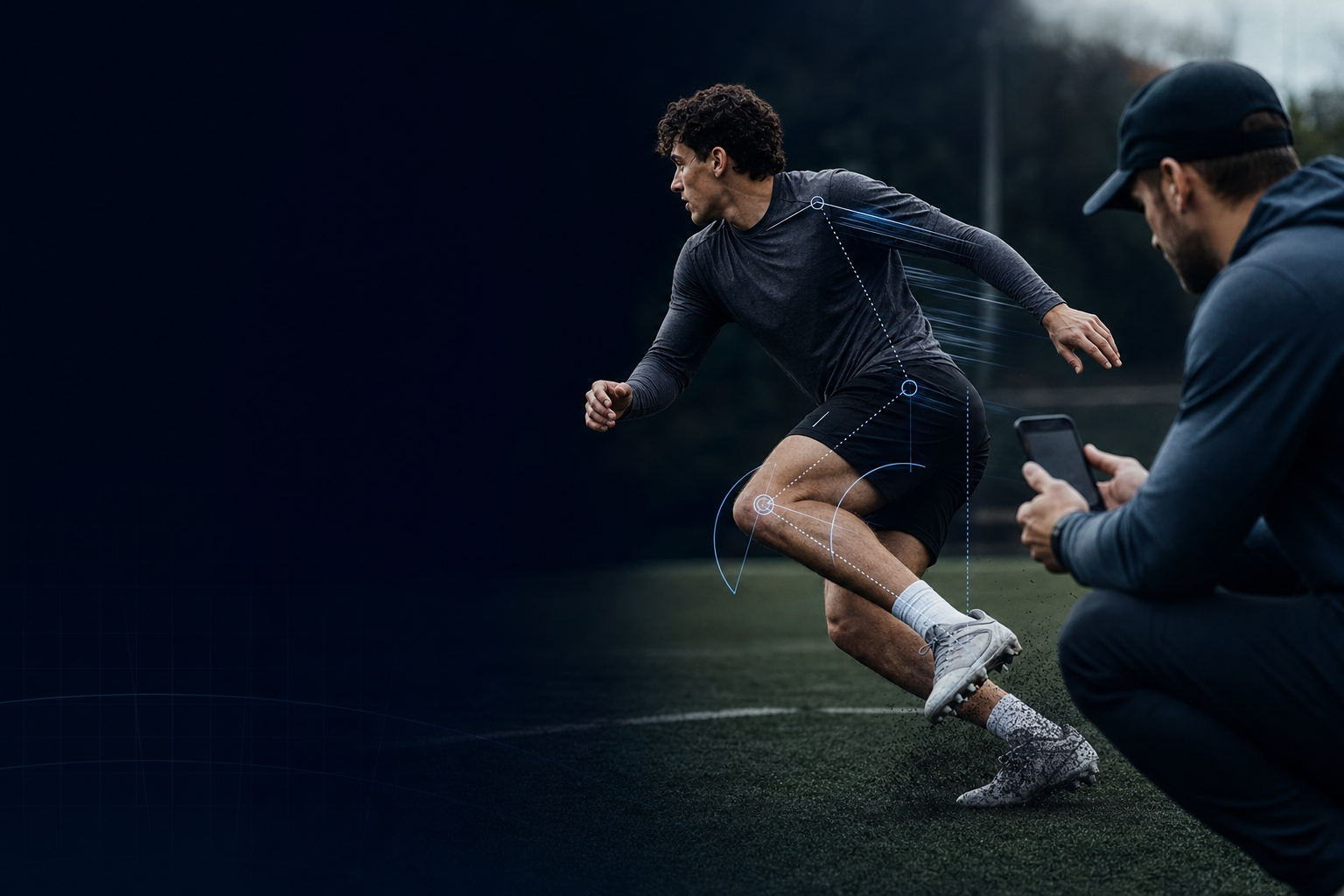
A coach does not need a lab to see a risky landing pattern. A simple phone video of a cut or a jump landing, filmed from the front, shows whether a knee is tracking over the toes or collapsing inward. A pattern that shows up consistently, on both legs, across multiple reps, is worth flagging. A pattern that only shows up once is probably noise.
Screen cutting and landing mechanics from a phone video
Greater reads a phone video for landing and cutting mechanics and keeps the clips and notes organized per athlete, so a flagged pattern does not get lost between practices.
See how Greater screens movementA screen is not a diagnosis. An athlete with a consistently risky pattern, or any athlete reporting pain, belongs with a physical therapist or physician, not with a coach's phone video alone.
For more on what a single video can and cannot tell you, see the landing mechanics breakdown.
Building this into a football team's practice schedule
Skill positions and special-teams players carry a disproportionate share of the risk shown above, but running the program as a team-wide practice opener, not an optional add-on for the injury-prone players, is what keeps it from quietly disappearing by October. Most small-school and youth programs do not have a strength and conditioning coach running the room every day, so the simplest version of the program, a consistent one, beats a more elaborate version that only gets run when staffing allows.
Run a consistent program without a dedicated S&C coach every day
Greater helps schools and athletic programs keep a prevention routine consistent across a roster, even without daily hands-on coaching.
Greater for schools and athletic programsThis is the same approach already cutting ACL risk in soccer, adapted here for football's own risk profile. The components are shared across sports; the emphasis on positions and timing above is what should change based on the roster in front of you.
After a tear: recovery timeline and continued prevention
Most ACL tears in football are complete tears, not partial ones, and a complete tear typically means surgery followed by a recovery measured in months rather than weeks. What changes before that surgery is its own topic, and it starts well before the operating room.
Returning to football after an ACL reconstruction is a decision for a surgeon and a physical therapist. It is built around the athlete's own healing and strength benchmarks, not a fixed calendar date. Prevention work does not stop once an athlete returns to play. A previously injured knee is a knee worth continued attention, not a finished project.
Support return-to-sport decisions with organized movement data
Physical therapy clinics use Greater to keep movement clips and progress for each athlete in one place through a return-to-sport timeline.
How Greater supports physical therapy clinicsFrequently asked questions
How common are ACL injuries in football?
In the National Football League, the one-season risk of a player tearing an ACL runs around 1.9 percent, based on five seasons of league injury data. That risk is not spread evenly. It concentrates by position and spikes during the preseason.
Why do ACL injuries spike in football preseason?
NFL data show preseason games carry an ACL injury rate more than double the regular season, and the gap is largest for players with three or fewer years of experience. Conditioning is typically lowest and contact volume ramps up fastest during preseason, which lines up with the spike.
Which football positions have the highest ACL injury rate?
Findings differ slightly by dataset. A five-season NFL dataset found special teams, defensive secondary, offensive line and defensive line carried the largest shares of total ACL injuries. A newer ten-season dataset found wide receivers and tight ends had the highest incidence, with kickers and punters the lowest.
Can a warm-up program actually prevent ACL tears in football?
No program removes the risk. Programs built on balance work, landing training, strength work and agility drills have cut ACL injury rates by roughly half to three-fifths in trials run in soccer, handball, basketball and volleyball, which is the best available evidence since no trial has tested this specifically in American football. The training components are not sport-specific, but a program only reduces the part of the risk that comes from non-contact mechanisms like cutting and landing, not the part that comes from contact.
Is a football ACL tear usually contact or non-contact?
It is more mixed than in many other sports. In a ten-season NFL dataset, 47 percent of ACL tears came from a contact mechanism and roughly a third came from non-contact mechanisms such as landing from a jump. That is a higher contact share than most other sports, where non-contact mechanisms generally account for 70 to 80 percent of ACL ruptures.
How long is recovery after an ACL tear in football?
Most ACL tears are complete tears, which typically require surgical reconstruction followed by a recovery measured in months. Return to football is a decision for a surgeon and physical therapist based on the individual athlete's healing and strength benchmarks, not a fixed calendar date, and prevention work continues after the athlete returns to play.