

Swimmer's Shoulder Exercises: A Coach's Dryland Routine (With Dosage and Progression)
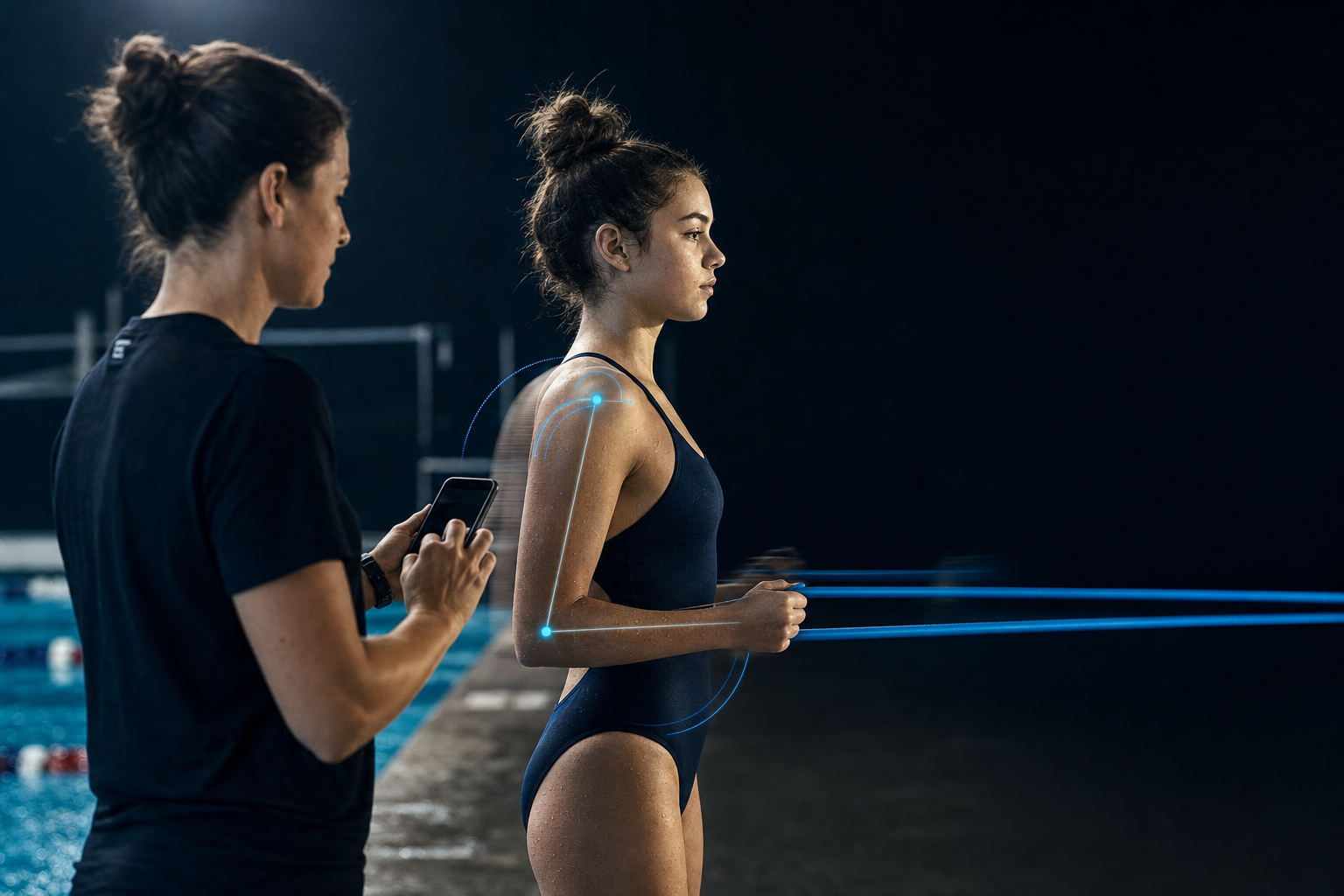
Search for swimmer's shoulder exercises and you get the same page twelve times. Five moves, a stock photo, no sets, no reps, no idea when to progress. None of it tells a coach what to do with a squad of thirty swimmers on a Tuesday.
This guide is the version with the missing parts. A dryland routine with actual dosage, a four-week progression, and the two risk factors worth checking before you pick a single exercise. It is written for swim coaches and strength coaches, and it works for an individual swimmer too.
One honest note first. No routine makes a shoulder injury-proof. The goal is to reduce risk and to catch problems early, not to guarantee anything. Pain that interferes with training is a referral, not a programming problem.
Why swimmers' shoulders break down
Shoulder pain is close to universal in competitive swimming. In a study of 80 elite swimmers aged 13 to 25, 91% reported shoulder pain, 84% had a positive impingement sign, and 69% of those who had an MRI showed supraspinatus tendinopathy.
That study also overturned the old explanation. Coaches were taught for years that swimmers got shoulder pain because years of overhead work stretched the joint into looseness, and the loose joint then pinched. The data did not support it. Joint laxity barely correlated with impingement pain. Training load did. Hours swum per week and weekly mileage both tracked with tendinopathy. Stroke preference did not.
The picture that holds up is simpler. The supraspinatus tendon is the tissue under the most repeated load in a freestyle pull. Load it hard enough for long enough and it changes. Longer swimming careers track with a thicker supraspinatus tendon and with lower self-reported shoulder function, even in swimmers who are still competing.
So the work has two halves. Build the tissue and the control that handle the load. Then manage the load itself. Most exercise lists only do the first half.
The two risk factors worth screening first
Before you hand a swimmer a routine, two things tell you who needs the most attention.
A 12-month study that followed 74 competitive swimmers found that swimmers whose shoulder external rotation range sat at either extreme, too much or too little, carried substantially higher risk of a shoulder pain episode than swimmers in the middle of the range. Both ends. A very mobile shoulder is not a safe shoulder.
The same study found that a previous episode of interfering shoulder pain was one of the strongest flags there is. Swimmers with a pain history were several times more likely to have another episode. If you only have time to identify a few swimmers to watch closely, start with the ones who missed sessions last season.
One more thing a coach can watch is scapular control. The shoulder blade is the base the arm works from, and altered shoulder blade motion is common in overhead athletes and shows up alongside shoulder problems often enough to be worth a look. Watch a swimmer raise both arms overhead slowly and lower them. One blade that wings off the ribs, shrugs early, or lags behind the other is worth a second look.
None of this is a diagnosis. It is a sorting tool. For how screening works in general, and what a score does and does not mean, see what a movement screen actually tells you.
The dryland routine
Eight exercises, three days a week, 15 to 20 minutes. It goes inside the dryland window or before the pool. It is not extra work bolted onto an already full week, because the first thing that gets cut from a swim program is always the thing that was added last.
The routine is built around four targets: internal rotation range, external rotation strength, shoulder blade strength, and thoracic plus hip mobility. Those four come from the exercise program with the strongest trial evidence behind it for reducing shoulder problems in overhead athletes. A trial of 660 elite handball players ran that program three times a week as part of the warm-up and found a 28% lower risk of shoulder problems across a season.
Be clear about what that does and does not mean. That trial was handball, not swimming. No equivalent trial has been run in swimmers. The targets transfer because they are the same risk factors that show up in swimmers. The exact size of the benefit does not automatically transfer with them.
| Exercise | What it targets | Sets and reps | Coaching cue |
|---|---|---|---|
| Cross-body or sleeper stretch | Internal rotation range | 3 x 30 seconds each side | Pin the shoulder blade down first. Rotate from the shoulder, not the spine. |
| Side-lying external rotation, light dumbbell | External rotation strength | 3 x 12 each side | Elbow stays against the ribs. Small range, slow, no body English. |
| Band external rotation at 90 degrees | External rotation strength in the swim position | 3 x 10 each side | Elbow at shoulder height. Stop the set when the low back starts arching. |
| Prone Y raise | Lower trapezius, shoulder blade upward rotation | 3 x 10 | Thumbs up. Lift from the shoulder blade. No shrug at the top. |
| Prone T raise or bench row | Mid trapezius and rhomboids | 3 x 10 | Draw the blades together and hold one second at the top. |
| Serratus wall slide | Serratus anterior, shoulder blade control overhead | 3 x 10 | Keep pressing into the wall the whole way up. Ribs stay down. |
| Open-book rotation or foam roller extension | Thoracic mobility | 2 x 8 each side | Exhale at the end range. Move the ribcage, not the low back. |
| Half-kneeling band pull with rotation | Kinetic chain, hips to arm | 2 x 10 each side | The hips start the movement. The arm finishes it. |
The loads here are deliberately light. Rotator cuff work is control work, not a strength contest. The broader evidence on this kind of programming is encouraging for pain and function: a review of randomized trials in rotator cuff impingement found exercise produced meaningful improvements in pain and function, and home programs performed no worse than supervised ones. That review covered treating shoulders that already hurt, not prevention. But the practical point stands for a squad. Swimmers can do this work without a coach standing over them.
How to progress it over four weeks
Weeks one and two are about positions. Most swimmers cannot hold a shoulder blade still through a Y raise on day one. Use the lightest band and the smallest dumbbell in the room, or no load at all. The target is ten clean reps, not ten reps.
Weeks three and four add load and time under tension. Move up one band colour or one dumbbell step. If the movement is still scrappy, add a one-second pause at the hardest point of each rep instead of adding weight.
The progression rule is one line. Add load only when the last rep of a set looks like the first. If rep ten shrugs, arches, or drifts, the swimmer is not ready for more and the set was already too heavy.
After four weeks it becomes maintenance. Two to three sessions a week, same exercises, occasional load changes. Shoulder work is not a block you finish. It runs as long as the swimming does.
The part most exercise lists skip: swim volume
The factor with the most consistent evidence behind it in swimmers is not an exercise. It is how much they swim, and how fast that number climbs. A review of 12 studies covering 1,460 swimmers found adolescent swimmers had the highest rates of shoulder pain of any age group. Weekly training volume differed between swimmers with shoulder pain and swimmers without it in the adolescent and masters groups. In adolescents, weekly volume and years of competing both tracked with supraspinatus tendon thickness.
The review's own caution is the important part. There is no validated volume cutoff. Nobody can tell you that 18 hours a week is safe and 22 is not. What the evidence supports is monitoring the number across the year and avoiding sudden large jumps, particularly in developing swimmers.
In practice that means three things. Know each swimmer's weekly volume rather than the squad's average. Ramp it gradually after a break instead of restarting where the season ended. And when a swimmer reports shoulder pain, look at the last three weeks of volume before you look at their rotator cuff.
Planning that curve across a season is a periodization problem. If that word has always been vague, start with the plain-language version of how periodization works.
Across a club with multiple squads, the hard part is seeing the numbers at all. Greater's approach for club and select programs is built around assigning the same work across groups and seeing who actually completed it, so load and compliance are visible instead of assumed.
Building it into the training week
Three sessions, spread out. Monday, Wednesday, Friday works. So does pairing it with the three dryland days a squad already has. Avoid stacking it the day before a heavy main-set day, since fatigued cuff muscles are not what you want going into a 6,000 metre session.
Make it the warm-up rather than the cool-down. Work placed at the end of practice is work that gets skipped when the session runs long, and swim sessions always run long. The mobility pieces warm the shoulder up anyway.
Name an owner. An assistant coach, a team captain, or the swimmer themselves for an individual. In the handball trial the program was delivered by coaches and captains, not by clinicians, which is part of why it was repeatable. For the wider weekly structure around it, see how to build a weekly strength and conditioning template.
Watching a swimmer's shoulder without a clinic visit
A coach does not need equipment to notice a change. Two things are worth filming on a phone every few weeks, from the front and from the side.
- A slow overhead reach with both arms. Watch for one shoulder that shrugs early, one blade that wings off the ribs, or an arm that stops short of the other.
- A serratus wall slide. Watch whether the blade stays flat against the ribs all the way up, and whether the swimmer can lower it under control.
Film the same two movements in the same spot each time. Changes are easier to see against the same background and the same camera angle than against memory.
Video is more useful than a one-off screening day because it is repeatable. The same logic applies in other sports: what a phone video can actually tell you is more about catching change over time than about grading any single rep.
Greater's movement analysis runs on ordinary phone video, so a coach can get an AI read on what the recording shows without a tripod or a scheduled screening session. Try the movement self-check on a single swimmer before deciding whether it belongs in your week.
What video cannot do is diagnose anything. It tells you who to watch and when something changed. That is all.
When to stop swimming and get it looked at
Some things are not programming problems. A swimmer should stop and see a physician or physical therapist when any of these show up.
- Pain that changes how they swim, or that stops a set.
- Pain at night or at rest.
- Weakness, numbness, or a shoulder that feels like it is slipping.
- Shoulder pain that has not settled after two weeks of reduced volume.
Do not answer any of those with a harder dryland routine. The routine in this guide is for shoulders that are currently healthy, or for maintenance work a clinician has cleared. Rehabilitation after an injury is a clinical decision and belongs with the person making it.
Where a swimmer is working with a clinic, keeping the training side and the rehab side in the same place helps. Greater's approach for physical therapy clinics is built for exactly that handoff.
Not every swimmer with shoulder pain needs the full dryland routine above. If the question is what is actually happening at the joint before committing to a program, our breakdown of shoulder impingement from swimming walks through what the stroke mechanics are doing to the joint and when pain is a signal to back off rather than push through.
Run the routine. See who actually did it.
Assign the dryland block to a swimmer or a whole squad, track completion session by session, and get an AI read on movement from a phone video.
Try Greater freeFrequently asked questions
What exercises help swimmer's shoulder?
The useful ones fall into four groups: internal rotation range work such as a cross-body or sleeper stretch, external rotation strength work such as side-lying and band external rotations, shoulder blade strength work such as prone Y and T raises and serratus wall slides, and thoracic plus hip mobility work such as open-book rotations and half-kneeling band pulls. Those four targets come from the exercise program that a trial in 660 elite handball players found reduced the risk of shoulder problems by 28% over a season. Loads stay light. This is control work, not a strength contest.
How often should a swimmer do shoulder exercises?
Three times a week, 15 to 20 minutes, inside the dryland or pre-pool window rather than added on top of it. The handball trial that produced the four training targets ran its program three times a week as part of the warm-up. After the first four weeks, two to three sessions a week as ongoing maintenance is enough. It runs as long as the swimming does.
Should a swimmer stretch the shoulder or strengthen it?
Both, but not indiscriminately. A 12-month study of 74 competitive swimmers found that external rotation range at either extreme, too much or too little, was associated with higher risk than range in the middle. So a very mobile swimmer does not need more stretching. The stretching in this routine targets internal rotation range specifically, and the bulk of the work is strength and control for the rotator cuff and shoulder blade.
Can dryland training prevent swimmer's shoulder?
No program makes a shoulder injury-proof, and nothing here should be read as a guarantee. The honest version is that an exercise program of this type reduced the risk of shoulder problems by 28% over a season in a trial of elite handball players, and no equivalent trial has been run in swimmers. Alongside the exercises, managing swim volume matters: a review of 12 studies in 1,460 swimmers found weekly volume differed between adolescent swimmers with and without shoulder pain, and the same held in masters swimmers.
When should a swimmer with shoulder pain stop swimming?
Stop and see a physician or physical therapist if the pain changes how they swim or ends a set, if there is pain at night or at rest, if there is weakness or numbness or a feeling of the shoulder slipping, or if shoulder pain has not settled after two weeks of reduced volume. A previous episode of interfering shoulder pain is also one of the strongest predictors of another one, so an episode that resolves still earns closer monitoring afterwards.