

Shoulder Impingement From Swimming: What the Stroke Is Actually Doing
Search shoulder impingement and swimming together and you get ten versions of the same page. Symptoms. Causes. Treatment. Rest, ice, see a specialist. Almost all of it is written for a swimmer whose shoulder already hurts.
That leaves the coaching question unanswered. Impingement in swimmers is not a random event. It is produced by a stroke, repeated thousands of times a week, and there is published work naming which parts of that stroke are doing it. There is also published work on when a shoulder problem is actually visible, which turns out not to be when most people look.
This page covers the mechanism, the three stroke faults tied to higher risk, the one range-of-motion number worth measuring, and a screening routine you can run on deck. It does not cover the dryland routine. That is a separate job and it already has its own page.
What shoulder impingement in swimming actually is
Shoulder impingement is the compression of rotator cuff tendons in the narrow space beneath the top of the shoulder blade. In swimmers the main driver is training load and the muscle fatigue it produces, not a structural problem with the shoulder. Tired muscles stop controlling the joint well. The humeral head translates further than it should, and the tendons get pinched.
Looseness in the joint gets named as the cause often enough that it is worth addressing directly. It is contested. When 80 elite swimmers were tested with a laxometer and scanned, laxity correlated only weakly with impingement pain and not at all with tendon damage, while hours swum per week and weekly mileage both did. Load is also the half of this you can change.
Two muscles do most of the suffering. The serratus anterior and the subscapularis are active through most of the pull-through phase of the stroke. They fatigue first. When they fatigue, the mechanics of the joint change, and the pinching follows.
One terminology note that matters. Swimmer's shoulder and shoulder impingement are not the same thing. Swimmer's shoulder is an umbrella term covering impingement syndrome, rotator cuff tendinitis, labral injuries, instability from ligament laxity, muscle imbalance, and nerve entrapment. Impingement is one of several things under that umbrella. A swimmer with shoulder pain does not automatically have impingement, which is exactly why a diagnosis belongs to a clinician and not to a coach.
How much load a swimming shoulder is under
The volume numbers explain why this is a load problem rather than an accident.
An elite swimmer may cover up to 14,000 metres in a day and perform around 2,500 shoulder revolutions in that same day. Across a week at that level the distance reaches 60,000 to 80,000 metres, roughly 30,000 strokes per arm. Competitive swimmers typically train five to seven days a week, sometimes twice a day.
Now add where the propulsion comes from. Roughly 90 percent of the driving force in swimming is torque at the shoulder. There is no equivalent of a leg drive to share the work. The joint doing the propelling is also the joint with the least bony protection, and it does it tens of thousands of times a week.
Put that together and a sore shoulder in a competitive swimmer is not surprising. It is the predictable result of a lot of repetitions through a demanding range.
How common it is, and who it shows up in
A multi-site survey of 671 US competitive swimmers aged 9 to 17 across six states found that 49 percent reported shoulder symptoms. Close to half the roster.
Three patterns in that data are useful to a coach.
Age and experience both matter. Swimmers aged 15 to 17 reported more pain and more disability than swimmers aged 9 to 10, and swimmers with more years in the sport reported more of both. More exposure, more symptoms.
History matters most. Of everything measured, a history of previous shoulder pain or traumatic injury was the strongest indicator of current pain, disability and dissatisfaction. The highest-risk athlete in the pool is usually the one whose shoulder bothered them last season.
That last point is worth sitting with, because it costs nothing to act on. No equipment, no assessment, no screen. Ask every athlete once a season whether a shoulder has hurt before, write it down, and you have identified your watch list.
The three stroke faults tied to higher impingement risk
This is where most coverage of this topic stops at "repetitive overhead motion" and goes no further. It can go further. Front-crawl swimmers have been measured with three-dimensional videography to identify the exact moments in the stroke when each shoulder was in an impinging position. The swimmers measured were male, so treat the numbers as the best available rather than as settled for every roster.
On average, the shoulder was impinging for about a quarter of the stroke time. The more telling finding is that each swimmer impinged in some trials and not in others. Same swimmer, same shoulder, different result. That points at technique rather than anatomy alone, which is good news: technique can be changed.
Swimmers at high risk shared three characteristics in how they stroked. A large amount of internal rotation of the arm during the pull. A late start to external rotation during the recovery. And a small body tilt angle. Removing those three traits is the stated route to reducing risk.
| Stroke fault | What it means | What it looks like on video | What to work toward |
|---|---|---|---|
| Large internal rotation during the pull | The upper arm rotates inward a long way while the hand pulls under the body. That narrows the space the tendons pass through. It happens at the moment the shoulder is loaded hardest. | From underwater or above. The elbow drops and rolls toward the midline. The thumb leads the hand entry. The hand crosses under the centreline. | A high elbow with the forearm pointing down. A hand that stays outside the midline through the pull. |
| Late initiation of external rotation during the recovery | On the way over the top, the arm stays rotated inward too long before turning out. The shoulder passes through its tightest position still internally rotated. | From the side. The elbow leads but the hand hangs behind and inward. The forearm only turns out near the end of the recovery. | Starting the outward rotation early in the recovery. The arm should already be turned out as it passes the shoulder. |
| Small body tilt angle | The torso stays flat instead of rolling. The shoulder then has to reach through a larger and more compressed range to clear the arm over. | From above or head on. Shoulders stay level through the stroke cycle. The body does not roll along its long axis. The recovering arm swings wide and low. | A consistent body roll to both sides. The recovering shoulder should clear above the water line. |
These are coaching cues, not diagnoses. A swimmer showing all three is not injured and a swimmer showing none is not immune. What the list gives you is something specific to look for, which beats watching a stroke and hoping something stands out.
Two things that matter less than coaches assume
Videography of front-crawl swimmers answered two questions that come up in almost every pool deck argument. Neither stroke speed nor hand paddles made a significant difference to how much of the stroke was spent impinging. Slow and fast stroking speeds came out the same. Trials with and without paddles came out the same.
That does not make paddles risk free. They add load, and load is the underlying problem. It does mean the impingement position itself was not created by the paddle, so swapping paddles out while leaving the three stroke faults in place is unlikely to solve much.
Breathing side is the opposite case. It did show up. Breathing to one side only was often associated with a small tilt angle on the breathing side, and in those cases the shoulder on that same side impinged more often. If a swimmer breathes exclusively to the right and the right shoulder is the sore one, that is worth a look before anything else.
Why the shoulder looks fine at the start of practice
This is the finding that should change what a coach actually does, and it is missing from the clinical condition pages that dominate this search.
Twenty swimmers with impingement and twenty with no known shoulder problem had their scapular mechanics measured before and after a normal swim practice. At baseline there was no difference between the groups. None. Measured cold, the impingement group looked like everybody else.
After practice, both groups were measurably fatigued. But the healthy swimmers showed no significant change in scapular mechanics, while the impingement group lost upward rotation of the shoulder blade. The conclusion drawn was direct: examining swimmers immediately after swimming may tell you more than a typical clinical exam.
Read that as a scheduling instruction. A shoulder screen run during a fresh warm-up is looking for a problem at the one moment it is least likely to appear. If you are going to look at a swimmer's shoulder, look at the end of the hard set, while they are tired. That is when the difference shows.
It also reframes what an athlete reporting "it only hurts late in practice" is telling you. That is not a minor complaint to be waved off. It is consistent with how this presents.
A deck-side screening routine you can run this week
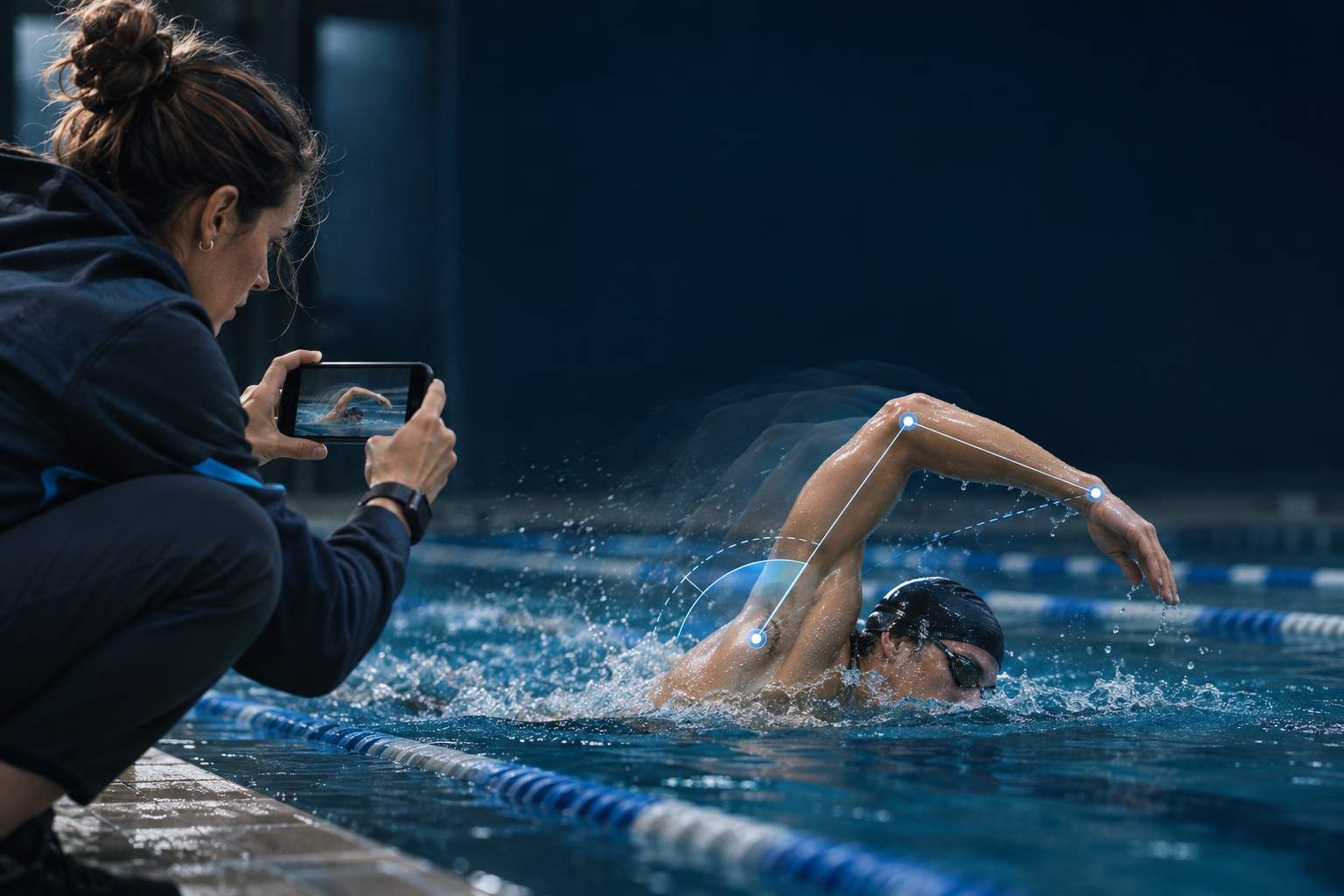
None of the above requires equipment beyond a phone. It does require consistency, because every one of these signals is read by comparison and not in isolation. The dryland post already covers filming an overhead reach and a wall slide on land. This is the in-water version, and what makes it different is when you film and what you score.
1. Collect shoulder history once per season. One question per athlete: has either shoulder hurt before, and which one. Write it down. This is the strongest single indicator in the survey data and the cheapest thing on this list.
2. Film at the end of the hard set, not the warm-up. Fatigue is what makes the problem visible. A fresh-shoulder video is a baseline at best and a false negative at worst.
3. Use two fixed angles, the same two every time. Head on and from the side, phone in the same spot, same lane, same distance. Changing the camera position between sessions makes two videos impossible to compare, which defeats the purpose.
4. Score the three stroke faults as present or absent. Do not grade severity. Internal rotation through the pull, late external rotation in the recovery, flat body roll. Present or absent, per arm. Severity scales drift between sessions and between coaches.
5. Note the breathing side, every time. If a swimmer breathes to one side only, flag the shoulder on that side for a closer look.
6. Re-film every three to four weeks, same angles. The signal is a fault that was absent and is now present at the tired end of practice, or a stroke that no longer looks like that athlete's own video from a month ago.
If you want a number rather than a yes or no, there is one measurement with some evidence behind it. Horizontal abduction is how far the arm travels backward when held out to the side at shoulder height. In a small prospective cohort of 24 young swimmers, it was the only one of seven range-of-motion measures that tracked with who went on to hurt, with a cut-off around 39 degrees.
Treat that as a cue and nothing more. The cohort was small, the authors describe the effect as a small predictor, and the paper reports its own accuracy two different ways. Nobody should be pulled from a squad over five degrees of shoulder range. What the measure is good for is tracking. Taken the same way by the same person at the same point in the week, a shoulder losing horizontal abduction across a block is telling you something. Running a repeatable movement screen covers how to make measurements comparable over time, which is the part that decides whether the number is worth anything.
The hard part of the routine is not the filming. It is keeping thirty athletes' videos and notes in an order where you can actually compare September to November, per athlete, per shoulder. Greater's movement self-check runs AI analysis on a phone video and keeps each athlete's clips and results in one place, so the comparison you want to make is against a filed clip rather than against memory.
The same logic applies to the notes around the video. Keeping screening results in one place across a squad is the difference between a screening habit that survives a season and one that stops in week three. And spotting a movement fault on film covers the general technique, which transfers directly from the pool deck to any other sport.
What strength work does and does not fix
Dryland work belongs in this conversation. It also has a limit that is easy to miss.
Eighteen adolescent swimmers ran a 12-week scapular training program. Each swimmer was assigned to a version built for strength or a version built for muscle endurance. Both improved absolute muscle strength. Neither improved scapular muscle endurance.
That is a small study, and it measured one set of programs rather than all of them. But the direction is worth taking seriously, because fatigue is the mechanism here. The muscles that fail are failing late in a session, after thousands of repetitions. A program that raises peak strength without raising fatigue resistance has not necessarily addressed the thing that produces the impingement position.
The practical reading: do the dryland work, and do not treat it as the whole answer. Volume management and stroke mechanics are not optional extras alongside it.
For the actual programming, the dryland routine, with sets, reps and a four-week progression covers what to run and how to dose it. This page deliberately does not repeat it.
When to stop and refer
Nothing on this page diagnoses anything. Screening finds candidates for assessment. It does not replace assessment, and the stroke faults above are coaching cues rather than clinical findings.
Send a swimmer to a physician or physical therapist when any of these are present:
Pain that is there at rest, not only in the water. Pain that wakes them at night or that is worse the next morning. Any loss of strength, or an arm that feels like it gives way. Pain that visibly changes stroke mechanics or drops performance. Symptoms that do not settle after reducing volume. Or a shoulder that has hurt before and is hurting again.
Reducing risk is a realistic goal. Preventing injury is not something any screening routine or training program can promise, and nobody should present it that way to an athlete or a parent. Where a clinician is already involved, Greater's approach for physical therapy clinics covers how screening data and a clinician's plan sit alongside each other rather than competing.
The survey that found half of young swimmers symptomatic closed by recommending exactly this: surveillance methods to identify symptomatic swimmers early enough to refer them. Catching it before it is a season-ending problem is the whole point of looking.
Run this across a whole squad
A screening habit holds up when the videos and notes stay organised per athlete. See how club and select programs set that up for a full roster rather than for the two swimmers a coach happens to remember.
Greater for club and select programsFrequently asked questions
Does swimming cause shoulder impingement?
Swimming does not cause impingement by itself, but the load it places on the shoulder makes it common. An elite swimmer may perform around 2,500 shoulder revolutions in a single day, and roughly 90 percent of propulsion comes from torque at the shoulder. In swimmers, impingement is driven mainly by muscle fatigue and joint laxity rather than bone shape. Close to half of young competitive swimmers in one large US survey reported shoulder symptoms.
Which part of the freestyle stroke causes impingement?
Three technique characteristics have been linked to higher risk in front-crawl swimmers: a large amount of internal rotation of the arm during the pull, a late start to external rotation during the recovery, and a small body tilt angle. Videography showed the shoulder spent roughly a quarter of the stroke in an impinging position on average, and the same swimmer impinged in some trials and not others, which suggests technique and not only anatomy.
Can you keep swimming with shoulder impingement?
That is a decision for a physician or physical therapist, not a coach, and it depends on the diagnosis and the symptoms. Shoulder pain in a swimmer has several possible causes and impingement is only one of them. Pain at rest, pain that wakes the athlete, any loss of strength, or symptoms that do not settle when volume is reduced all warrant assessment before continuing to train.
Do hand paddles make shoulder impingement worse?
Probably not on their own. When front-crawl swimmers were measured with three-dimensional videography, trials with and without hand paddles showed no significant difference in how much of the stroke was spent in an impinging position, and the same was true for slow versus fast stroking speeds. Paddles still add load, and load is the underlying problem. But removing paddles while leaving the stroke's internal rotation, late external rotation and flat body roll in place is unlikely to change much on its own.
Does breathing to one side cause shoulder pain?
It is associated with it. Breathing to one side only was often linked to a small body tilt angle on the breathing side, and in those cases the shoulder on that same side showed a higher incidence of impingement. If a swimmer breathes exclusively to one side and that same shoulder is the sore one, the breathing pattern is worth examining early.