

Ankle Injuries in Soccer: Types, Timelines, and What to Do Next
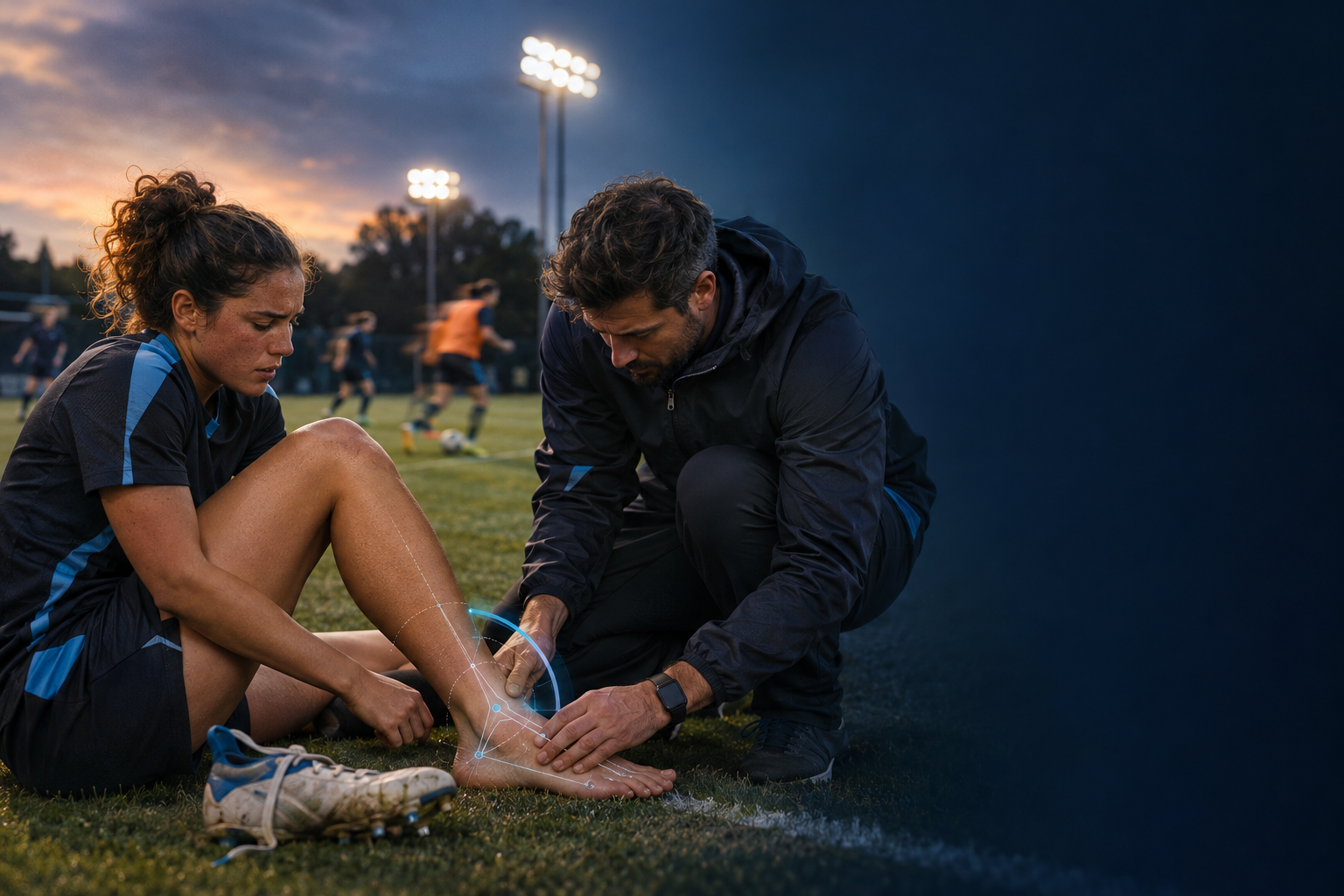
A player goes down after a tackle. The ankle is already swelling. Nobody on the touchline knows whether this is a three day problem or a three month one.
This page covers what ankle injuries soccer actually produces, how they happen on a field, and what the research reports about time away. It will help you describe what happened and decide what to do next. It will not tell you what the injury is. That is a clinician's job, and the red flags section below says when to get one involved.
The short answer
Ankle sprains are the most common ankle injury in soccer. Most are inversion sprains, also called lateral ankle sprains. The foot rolls inward and the ligaments on the outside of the ankle take the load. In an 11 year study of men's elite European football, lateral ligament sprain accounted for 51 percent of all ankle injuries, and ankle injuries made up 13 percent of all injuries recorded.
A smaller share are high ankle sprains, also called syndesmotic sprains. These involve the ligaments binding the two shin bones together just above the joint. They matter more than their frequency suggests, because players are out longer. In a video analysis of 140 ankle sprains in elite men's leagues, the median time away was 36 days overall. High ankle sprains ran a median of 52.5 days against 31 days for inversion sprains.
Two things follow from the research, and both cut against the usual advice. The mechanism is usually contact, not clumsiness. And the single biggest risk factor for the next sprain is the one the player just had, so how the return is handled matters more than how quickly it happens.
How common ankle injuries are in soccer
Ankle injuries are among the most common injuries in the elite men's game, at 13 percent of all injuries recorded over 11 years of surveillance. That same surveillance work put the ankle injury rate at 1 per 1000 hours of exposure. Sprains specifically ran at 0.7 per 1000 hours.
Most ankle injuries in the sport are sprains rather than other injury types. A systematic review of ankle sprain risk factors in soccer reports the share at roughly 77 percent.
Recurrence is the number worth sitting with. A review of ankle sprain epidemiology reports that 19 percent of ankle sprains in soccer were repeat injuries. In college athletics, women's soccer recorded 1.30 ankle sprains per 1000 athlete exposures.
One encouraging trend. Across the 11 years of the elite study, ankle sprain rates fell by an average of 3.1 percent per season, a statistically significant decline. The study did not establish what caused it.
The four ankle injuries soccer actually produces
Four patterns cover almost everything a soccer team sees. The timelines below are what studies report for groups of players. They are not a prediction for any individual, and they are not a schedule to work back from.
| Injury | What gets damaged | How it usually happens | What studies report for time away | Get it assessed when |
|---|---|---|---|---|
| Inversion sprain (lateral) | Ligaments on the outside of the ankle | Foot rolls inward, most often after contact in a tackle | Median 31 days in elite men's match injuries | Cannot bear weight, tenderness directly on bone, or no improvement after a few days |
| High ankle sprain (syndesmotic) | Ligaments binding the two shin bones together above the joint | Rotation through a planted foot, often with the toe caught in the ground | Median 52.5 days in elite men. Across athlete studies, mean 39.3 days without surgery and 70.9 days with surgery | Pain above the joint line rather than below it, pain when the ankle is rotated, or a recovery that stalls. These are reasons to refer, not a way to name the injury |
| Eversion sprain (medial) | Ligaments on the inside of the ankle | Foot rolls outward. Less common than inversion | Median 39 days in elite men, not statistically different from the other two sprain types | Same red flags as any sprain |
| Footballer's ankle (anterior impingement) | Bone and soft tissue at the front of the joint | Builds over seasons of repeated kicking rather than in one moment | An uncommon cause of time loss. Counted at 3 percent of ankle injuries in the elite study | Pinching at the front of the ankle when pointing the foot up or striking a ball |
Sources for the table: the median lay-off figures by injury type and the mechanism descriptions come from the video analysis of elite match ankle sprains, the surgical and nonsurgical day figures from the meta-analysis of return to play after high ankle sprains, and the impingement share from the 11 year elite surveillance study.
The two studies disagree on how common high ankle sprains are, and it is worth knowing why. The 11 year surveillance study counted syndesmotic sprains at 3 percent of all ankle injuries. The video analysis counted them at 21 percent of the sprains in its sample. The denominators differ, the samples differ, and the video study drew its cases from match footage and media reporting rather than club medical records. Read the surveillance figure as the share of a season's ankle problems and the video figure as the share of a set of filmed match sprains.
How it happens on a soccer field
This is the part most soccer ankle advice gets wrong. The video analysis categorised half of the 140 injuries as direct contact. Another 30 percent were indirect contact. Only 20 percent were non-contact.
By what the player was doing at the time:
- being tackled: 59 of 140 injuries, 42 percent
- tackling or pressing: 34 injuries, 24 percent
- landing from a jump: 16 injuries, 11 percent
- sliding: 7 injuries, 5 percent
Injuries happened more often in attacking play, 64 percent, than in defending, 36 percent.
Two conclusions follow. Balance and strength work cannot undo a mistimed tackle by an opponent. It still matters, for reasons in the section below, but any page selling it as the whole answer is overselling. And officiating is part of the picture: the elite study found foul play was involved in 40 percent of match related ankle sprains.
For the fifth of injuries that were non-contact, the video study documented a neurocognitive error in 59 percent of them. The player was reacting to the game, not simply moving badly. The other high cost non-contact injury in soccer tends to happen in the same kind of moment.
Red flags that need a clinician, not ice
A coach or parent is not ruling anything out here. The only question is whether this needs professional assessment, and the answer is yes more often than people assume.
Get an ankle assessed the same day if any of the following is true:
- the player cannot take four steps on it
- there is tenderness directly on the bone at the back edge or the bottom tip of either ankle knob
- there is tenderness on the bones along the outside or inside of the midfoot
- the ankle looks deformed, or swelling is immediate and severe
- pain sits above the joint line rather than below it, or hurts when the ankle is rotated
- nothing is improving after a few days
The first three of those come from the screening rules clinicians use to decide whether an injured ankle needs an X-ray. Across a review of 32 studies with a combined population of 15,581, 27 of them pooled, sensitivity ran from 96.4 to 99.0 percent, which the reviewers summarise as high sensitivity, almost 100 percent. Specificity is modest, from 26.3 to 39.8 percent.
In plain terms, those rules are very good at telling a clinician that an ankle probably is not fractured. They are not good at confirming that it is. That is the correct trade for a screening tool, and it is also why the rules belong in a clinician's hands rather than a coach's. Use the list above as a reason to refer, not as a verdict.
If in doubt, refer. An unnecessary assessment costs an appointment. A missed fracture costs a season.
What the first week usually involves
Treatment decisions belong to whoever is treating the player. What follows is only what the evidence base looks like, so you can tell whether the advice you are getting is current.
An umbrella review of 24 systematic reviews on acute ankle sprain management, and the reviews inside it, reached two clear conclusions and one uncomfortable one. Functional treatment, meaning early protected movement rather than being locked in a boot, came out preferable to immobilization. Bracing came out better than other forms of external support for functional outcomes. And there is no evidence about the effectiveness of RICE therapy, the rest, ice, compression and elevation routine most of us were taught.
That last finding is not a claim that ice causes harm. It is a claim that the research has not shown the package works. What the review does support is the direction of travel: early functional treatment under a clinician's guidance came out ahead of immobilization. It does not prescribe how, and neither does this page.
None of this replaces an assessment. Get the player seen, then follow the plan the clinician gives you.
The return to soccer decision
Days on a calendar are the wrong unit. The medians in this article describe populations, not the player in front of you, and the recurrence data says a rushed return is expensive.
Use criteria instead. A player is a candidate to return to full training when all of these are true:
- a clinician has cleared them
- swelling does not increase in the 24 hours after a full session
- single leg balance looks the same on the injured side as on the other side
- they can cut, decelerate and change direction at full speed without pain
- they can do all of that without thinking about the ankle
- they have finished the rehab work, rather than stopped when it felt better
The last two matter more than they sound. The mechanism in soccer is mostly contact and mostly reactive. A player still protecting an ankle under pressure is a player who will take a tackle badly.
Returning to play is the likely outcome, even for the sprain type that keeps players out longest. A meta-analysis of high ankle sprains in athletes found an overall return to play rate of 99 percent, with a mean of 52.32 days across 18 studies and 1133 sprains. Returning well is the part that depends on the criteria above.
This list is a conversation starter with the person treating the player. It is not clearance and it does not replace it.
Why ankle sprains come back, and what lowers the risk
Nineteen percent of soccer ankle sprains are repeats. The review of risk factors in soccer names previous ankle sprain as the most significant risk factor for a future one. One trial it includes put the adjusted incidence rate ratio at 2.29, with a confidence interval from 1.23 to 4.28.
The longer view is harder reading. The epidemiology review reports chronic ankle instability in 40 percent of people one year after a first lateral sprain, and notes that up to 70 percent may develop it. Chronic instability means an ankle that keeps giving way, keeps hurting, or both.
Three interventions have trial evidence behind them. Every figure below is risk reduction, not elimination.
| Intervention | What the research found | Best fit |
|---|---|---|
| Balance training | Risk ratio 0.54 across 3,577 athletes in a meta-analysis, a 46 percent lower sprain risk. A trial in 765 high school soccer and basketball players found 1.13 sprains per 1000 exposures with training against 1.87 without, a risk ratio of 0.56 | Every player, and not optional after a sprain |
| Bracing | Risk ratio 0.36 across 3,581 athletes, a 64 percent lower sprain risk | Players with a previous sprain, through the season |
| Multicomponent prevention programs | Risk ratio 0.615, with a confidence interval from 0.512 to 0.739, for injuries overall. Pooled from 12 trials inside a review of 19 studies covering 28,200 youth soccer players | Whole squad, built into the warm-up rather than added on |
Sources for the table, in order: the bracing and balance training meta-analysis, the high school balance training trial, and the meta-analysis of prevention programs in youth soccer.
Two caveats worth stating plainly. The pooled bracing and balance figures are published without confidence intervals, so treat them as point estimates rather than precise effects. And the youth soccer program figure is for injuries overall, not for ankles specifically.
The same trial that found balance training roughly halved sprain risk also found that a history of ankle sprain carried a risk ratio of 2.14. That asymmetry is the thing to plan around. Prevention work is cheap. A second sprain is not.
For the program itself, the ankle injury prevention guide covers dose and content, and the balance exercise progressions are the kind the trials used. Neither needs repeating here.
Running this across a squad
The hard part is not knowing what to do. It is knowing who is actually doing it.
On a squad of 20 you will usually have a few players mid rehab, a few wearing braces, and a handful who quietly stopped their ankle work the week it felt better. That last group is the one that turns up injured again.
What makes it manageable is visibility. Who is on a return plan, what stage they are at, and whether this week's work actually got done. Greater lets you track completion across every roster from one view, which is the difference between a prevention program on paper and one that is running.
Where this sits in the training week is covered in the soccer strength training program.
The bottom line
Most soccer ankle injuries are inversion sprains, and most of those happen through contact in a tackle rather than through bad movement. High ankle sprains are less common but keep players out materially longer. Any ankle that cannot take four steps, is tender directly on bone, or hurts above the joint line needs assessing the same day.
The decision that matters most is not how fast a player comes back. It is whether they come back meeting criteria, with the balance and strength work finished. Nineteen percent of these injuries are repeats, and the first sprain is the best predictor of the second.
See who actually finished their ankle work
Greater tracks assigned programs across every roster, so return to play plans and prevention work do not quietly stop.
Try Greater freeFrequently asked questions
What is the most common ankle injury in soccer?
The lateral ligament sprain, usually called an inversion sprain, where the foot rolls inward and the ligaments on the outside of the ankle take the load. In an 11 year study of men's elite European football it accounted for 51 percent of all ankle injuries. High ankle sprains and footballer's ankle are less common but take players out for longer.
Can I still play soccer with a sprained ankle?
That is not a question to answer from a web page. Get the ankle assessed first, especially if the player cannot take four steps on it, is tender directly on bone, or has pain above the joint line. Playing on an under rehabbed ankle is how a single sprain becomes a recurring one, and 19 percent of ankle sprains in soccer are repeat injuries.
How do I tell if my ankle injury is serious?
You cannot tell for certain without an assessment, and the point of the red flags is to decide whether to get one. Inability to bear weight, tenderness directly on the bone at the back edge or the bottom tip of either ankle knob, tenderness on the midfoot bones, obvious deformity, immediate severe swelling, pain above the joint line, or no improvement after a few days all mean the same thing: see a clinician the same day.
How long before I can play soccer again?
Study medians give a rough sense of scale rather than a timeline for any individual. In elite men's match injuries the median time away was 36 days overall, 31 days for inversion sprains and 52.5 days for high ankle sprains. A meta-analysis of high ankle sprains in athletes found a mean of 52.32 days and a 99 percent return to play rate. Return should be decided on criteria met, not days elapsed, and the clinician treating the player makes that call.
Do ankle braces actually work?
The evidence supports them as a way to reduce risk, not remove it. A meta-analysis found a risk ratio of 0.36 for bracing across 3,581 athletes, a 64 percent lower sprain risk. The pooled figure is published without a confidence interval, so treat it as a point estimate. Bracing is a particularly reasonable choice for a player with a previous sprain.
How do I stop ankle sprains coming back?
Finish the rehab rather than stopping when it feels better, keep balance training in the week, and consider a brace through the season if there has been a previous sprain. Balance training showed a risk ratio of 0.54 in a meta-analysis and 0.56 in a high school trial. Multicomponent prevention programs in youth soccer cut overall injury likelihood with a risk ratio of 0.615. None of these eliminates the risk.